


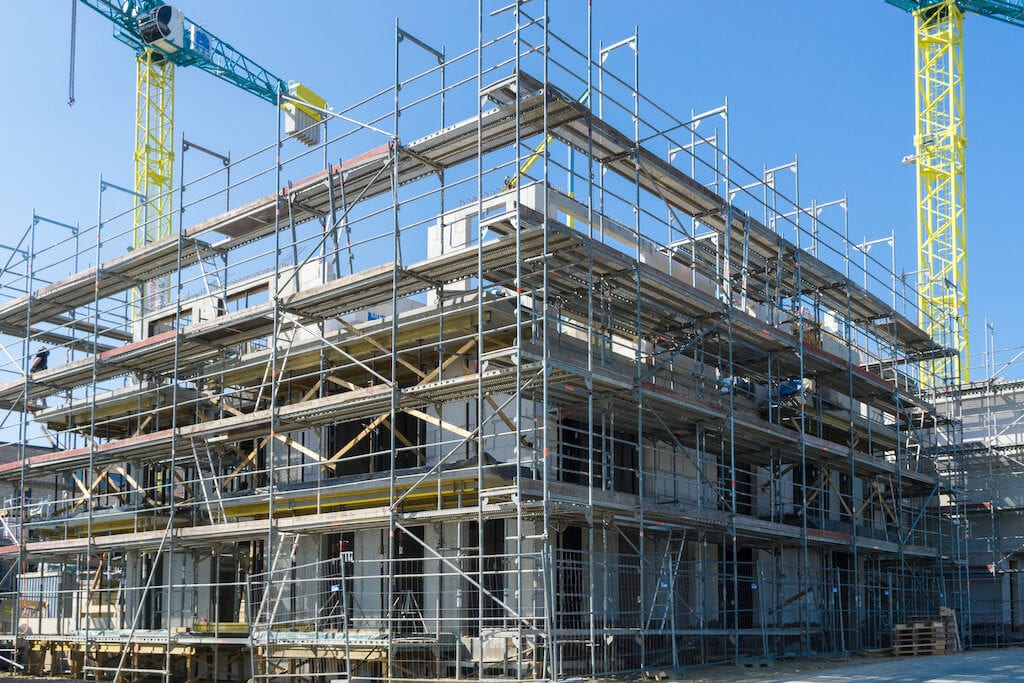
A Fabricated Frame Scaffold is a widely use scaffold system made from prefabricated end frames that include vertical posts, horizontal supports, and intermediate members. These frames support working platforms, creating a stable structure for tasks performed at height.
Known for its versatility and ease of use, the fabricated frame scaffold is commonly use in both small-scale and large construction projects, providing safe and efficient access for workers.
How Fabricated Frame Scaffold Works
A fabricated frame scaffold is assemble by connect modular frames with braces and platform to form a secure work structure. The system is design to be easily stack and extended vertically.
Key elements include:
- Prefabricated Frames: Provide the main structural support.
- Cross Bracing: Maintains stability and prevents movement.
- Platforms: Offer a safe working surface for workers.
- Base Support: Includes base plates and mud sills for a stable foundation.
Proper alignment, leveling, and securing of all components ensure the scaffold remains safe during use.
Fabricated Frame Scaffold Fall Protection
The primary hazard on fabricated frame scaffolds is worker falls. Fall protection must be provided on all scaffolds 10 feet or more above a lower level. This includes either personal fall-arrest systems or guardrail systems.
General Fall P rotection Requirements:
- Employees work on scaffolds ≥10 feet above a lower level must be protect from falling.
- Fall protection must meet OSHA standards.
- Overhand bricklaying operations require protection on all open sides except the side next to the wall.
- Employers must provide fall protection during erection or dismantling when feasible and safe.
Fall Arrest Systems
- Personal fall-arrest systems must comply with 29 CFR 1926.502(d).
- Attach lanyards to:
- Vertical lifeline
- Horizontal lifeline
- Scaffold structural member
- Vertical lifelines:
- Fasten to a fixed anchorage independent of the scaffold.
- Protect from sharp edges and abrasion.
- Do not attach multiple vertical lifelines to the same point.
- Horizontal lifelines:
- Must be secure to two or more scaffold structural member
Handrail Systems
- Install along all open sides and ends of platforms before use.
- Walkways must have rails within 9½ inches of at least one side.
- Top rails must withstand 200 lbs downward or horizontal force.
- Top rail height: 36–45 inches (minimum 38 inches for scaffolds post-Jan 1, 2000).
- Midrails, screens, mesh, intermediate vertical members, and solid panels: withstand 150 lbs of force.
- Midrails are install midway between the top rail and the platform.
- Screens/mesh must extend from the top rail to the platform.
- Intermediate members ≤19 inches apart.
- Surface handrails to prevent punctures, lacerations, and clothing snags.
- Ends of rails must not extend beyond terminal posts unless safe.
- Alternative: Crossbracing can serve as top/midrail if:
- Midrail: 20–30 inches above the platform
- Toprail: 38–48 inches above platform
Benefits
Using a Fabricated Frame Scaffold offers several advantages:
- Easy Assembly: Quick setup and dismantling save time and labor.
- Cost-Effective: Economical solution for temporary access needs.
- Versatile Design: Suitable for both small and large projects.
- Stable Structure: Provides reliable support when properly installed.
With proper installation and safety measures, fabricated frame scaffolds help improve productivity while maintaining worker safety.
Fabricated Frame Scaffold Accidents
Scaffolding can be extremely hazardous when not properly installed or maintained. Poor bracing, substandard materials, unsafe construction, and failure to follow safety regulations are common causes of accidents.
Accident Statistics
- Approximately 2.3 million construction workers (65% of the industry) work on scaffolds regularly.
- Scaffold-related accidents cause roughly 4,500 injuries and 50 deaths per year, costing employers millions in lost workdays.
- 72% of injuries are due to:
- Planking or supports giving way
- Slipping
- Struck by fall objects
Essential Safety Measures
- Base Plates & Mud Sills: Ensure the foundation is firm and stable.
- Scaffold Ties:
- The first tie must be properly secure.
- Subsequent ties should not exceed 26 feet in height.
- Horizontal spacing of ties must not exceed 30 feet.
- All ties must withstand 2,500 lbs of push or pull force.
- Additional ties may be require to ensure full scaffold stability.
Legal Considerations
- Some firms offer free evaluations to determine if legal action is justified.
- Experienced scaffolding lawyers can help if injuries occur.
Scaffolding Rental vs. Semi-Permanent Metal Modular Platforms
Renting or leasing typical metal scaffolding for semi-permanent or longer-term applications has many disadvantages and some are just downright UNSAFE if not installed correctly. Not the least of which is that scaffolding must be reinspectnd re-certified on a regular basis. Sometimes creating timely delays and costly fines if not performed on time.
Because traditional metal scaffolding is meant for temporary access in construction or maintenance application, its design is not fully suited for longer-term applications. ErectaStep solves that problem; simply configure, install, and forget about it. Learn More

Source: OSHA.gov
Fabricated Frame Scaffold Base Section
It is impossible for a stable structure to be built upon a foundation that does not start out square and level. OSHA has stand that apply specifically to the steps that must be taken to assure a stable scaffold base.
- In order to assure stability, support scaffolds must be set on:
- Base plate,
- Mud sills
- Or other adequate firm foundation
- Footings must be capable of supporting the loaded scaffold without settling or displacement.
- Unstable objects may not be used to support scaffolds or platform units.
- Front-end loaders and similar pieces of equipment shall not be used to support scaffold platforms unless they have been specifically designed by the manufacturer for such use.
- Forklifts shall not be used to support scaffold platforms unless :
- The entire platform is attached to the fork.
- The forklift is not moved horizontally while the platform is occupied.
Fabricated Frame Scaffold Plumb
Supported scaffold poles, frames, uprights, etc. must be plumb and braced to prevent swaying and displacement. In general, a level is the easiest way to achieve the desired right angles.
Support Structure
To control the risk of a scaffold falling or collapsing, employers must assure that scaffolds are built within OSHA stand relating to strength and structural integrity.
NOTE: Except where indicated, these requirements also apply to manually propelled, pump jack, ladder jack, tube and coupler, and pole scaffolds, as well as the specialty scaffolds described in the Supported Scaffolds module.
Capacity
- Scaffolds and scaffold components must be capable of supporting, without failure, their own weight and at least 4 times their maximum intended load.
- Scaffolds shall be altered only under the supervision and direction of a competent person.
Bracing
- Frames and panels must be connected by cross, horizontal, or diagonal braces, alone or in combination, which secures vertical members together laterally.
- As frames are stacked, cross braces must be of such length as will automatically keep the scaffold plumb, level, and square.
- All brace connections must be secured to prevent dislodging.
Pinning
- Frames and panels must be joined together vertically by coupling or stacking pins or equivalent means.
- Frames and panels must be locked together to prevent uplift, where uplift can occur. Uplift is the separation of a frame from the frame below it.
Components
- Intermixing Parts: Scaffold component from different manufacturer must not be combine unless they fit together naturally without force, and the scaffold’s structural integrity is preserve.
- Modifying Parts: Components cannot be altered to make them fit together unless a competent person confirm that the scaffold remains structura safe.
- Dissimilar Metals: Scaffold parts made of different metals should only be used together if a qualified professional determines that galvanic corrosion or other metal interactions will not weaken the scaffold below OSHA stand.
Access
Workers are most vulnerable to fall hazards when climbing on or off a scaffold. Therefore, employer are require to provide safe scaffold access. Erectors and dismantlers face additional access problems due to the incomplete condition of the scaffolding. Required to prevent falls that apply only to these workers are address separately below.
Applications
- Construction Projects: Access for building, repair, and maintenance work.
- Residential Work: Commonly used by painters and contractors.
- Industrial Maintenance: Supporting work on large structures and equipment.
- High-Rise Projects: Can be stack for multi-level access in large-scale jobs.
It is a scaffold system made of prefabricated frames that support platforms for work at height.
It is use in construction, residential projects, industrial maintenance, and large-scale building work.
Yes, when properly installed with bracing, base support, and fall protection systems.
It is easy to assemble, cost-effective, and adaptable to different project sizes.