




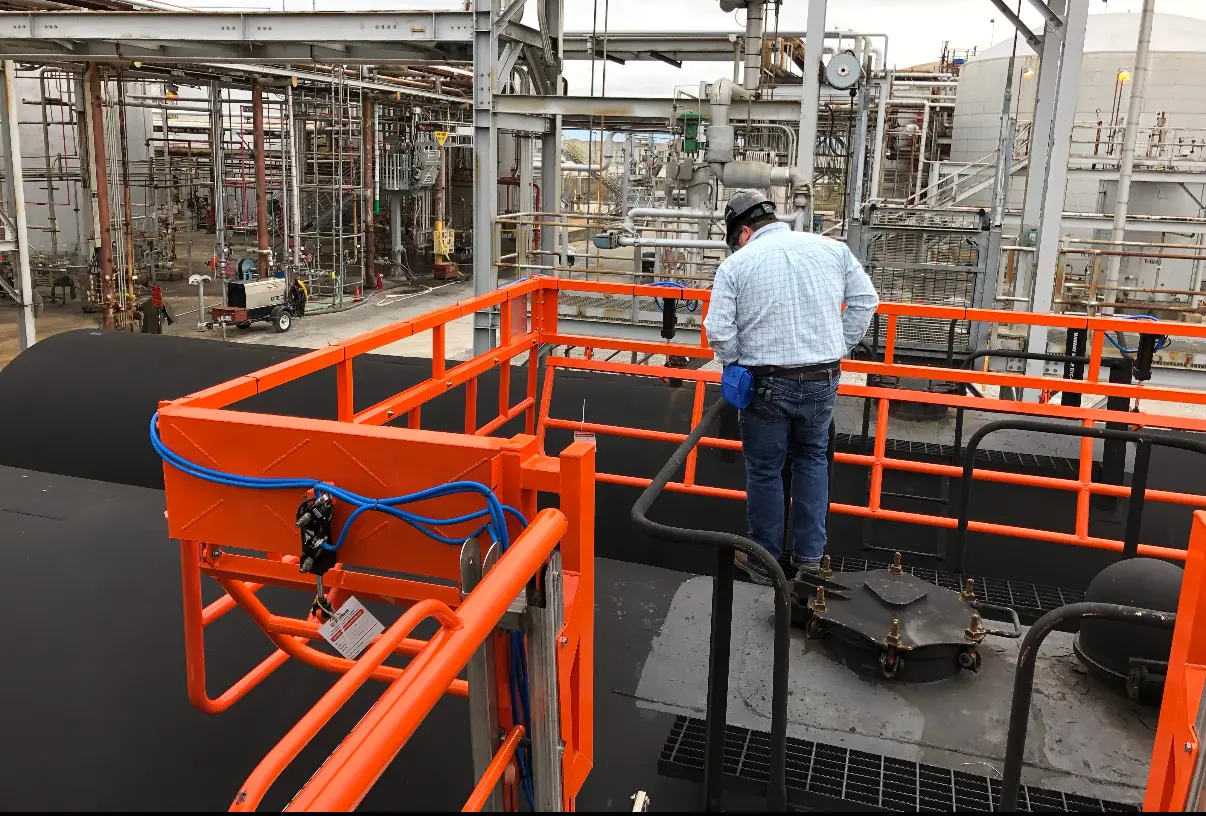
High‑visibility (high‑vis) powder coating has quietly moved from “nice‑to‑have” to “why wouldn’t you?” on a lot of industrial sites. Across terminals, loading racks, and heavy industrial job sites, color is no longer just an aesthetic decision; it’s a practical safety control that affects how quickly people see equipment, how they orient themselves, and how they move through the work zone. Viewed in this way, high‑vis powder coating belongs as much in a risk assessment as it does in a spec sheet.
High‑Visibility in Truck and Rail Loading Environments
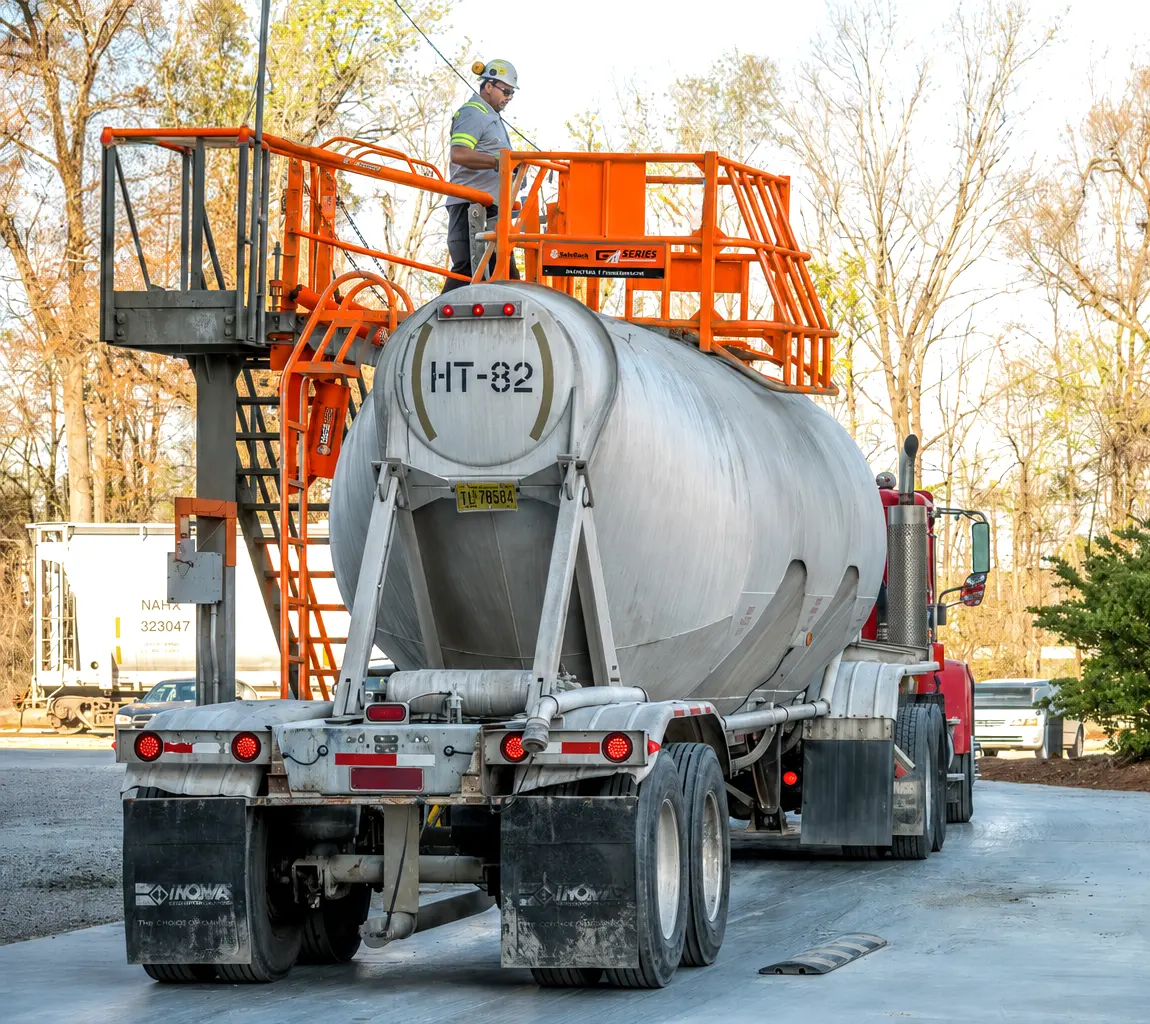
SafeRack designs and manufactures industrial access and fall‑protection equipment—truck and railcar loading racks, gangways, safety cages, platforms, and related systems that let operators safely reach hatches, valves, and connections at height.
A truck loading rack is a fixed platform and access system installed alongside the lanes where trucks park to load or unload. It typically includes a walkway or platform, a pivoting gangway that reaches the truck or railcar, and a safety cage or guardrail envelope that provides fall protection at the top of the vehicle. A MultiSpot loading rack is an access platform designed with multiple loading positions—several spots where trucks can pull in and be serviced—so a facility can handle more traffic without building separate racks for each lane.
These structures are the “front door” to bulk loading operations, where liquids, powders, and granules are transferred to and from trucks and railcars.
For readers who don’t live in this world every day, think of a MultiSpot Rack as a high‑traffic curbside loading zone, but elevated and wrapped in steel: trucks pull under, operators climb up, and product moves quickly. In that environment, the visibility of the access equipment itself becomes a safety factor.
Visibility as a First Line of Defense
When new access or fall‑protection equipment shows up on a site, it’s almost always some shade of neutral: galvanized steel, mill‑finish aluminum, light gray. It looks clean on install day and matches just about any setting. But spend a few weeks in a bulk terminal or chemical plant, and that finish starts to tell a different story. Dust settles in, cement particulate hangs in the air, overspray and grime build up on every surface. The “clean” gray slowly turns into the same matte gray as everything else around it.
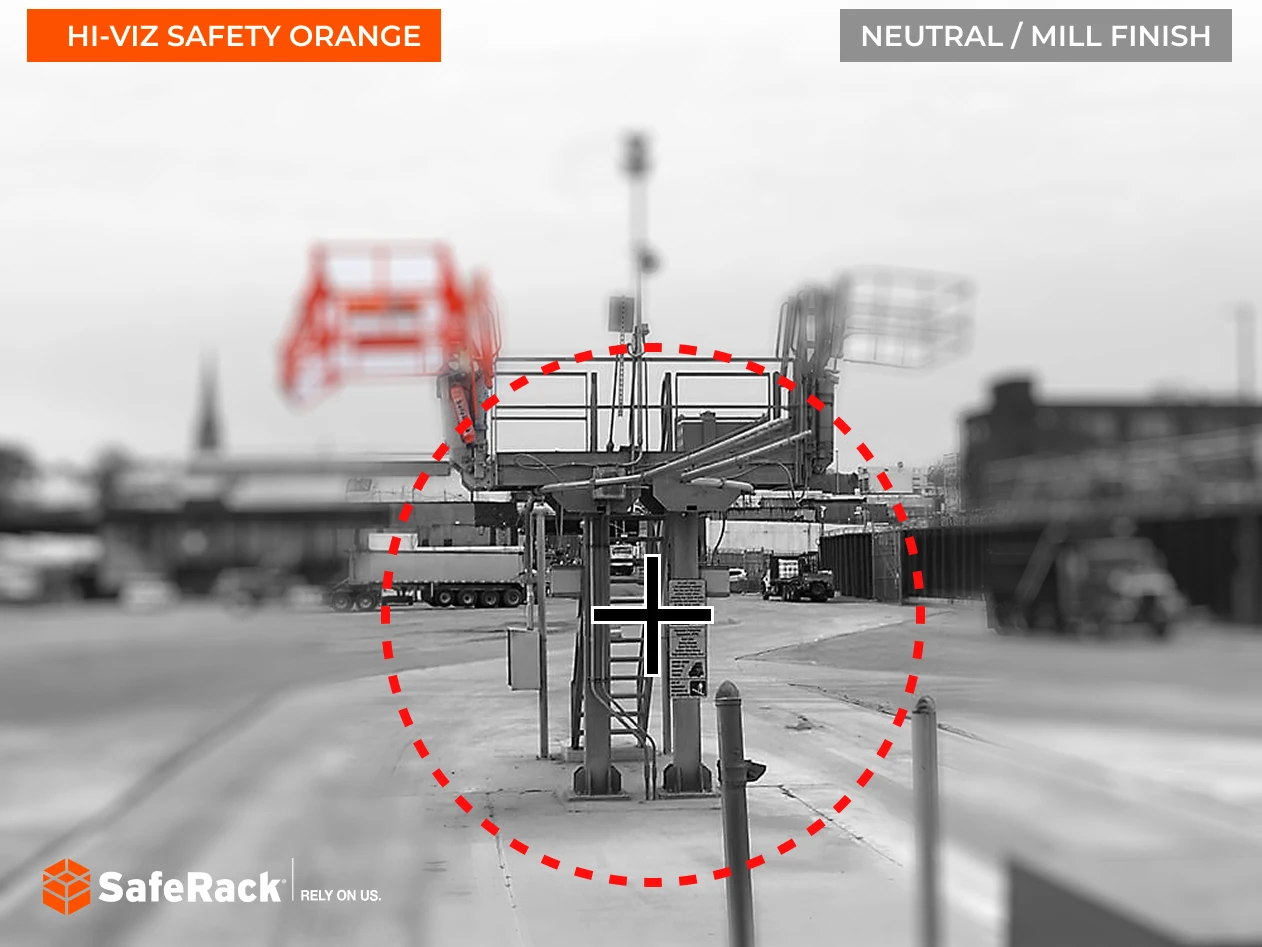
And that’s the problem. In a yard full of gray trailers, gray pipe racks, and gray platforms, a gray cage or gangway becomes part of the background. From the cab of a truck, especially at a distance, it doesn’t naturally stand out as something to slow down for or steer around. High‑visibility powder coating is designed to break that blend. Safety orange and similar high‑vis finishes punch through the visual noise and give drivers a clear edge line around the equipment, even when the environment is dusty or overcast.
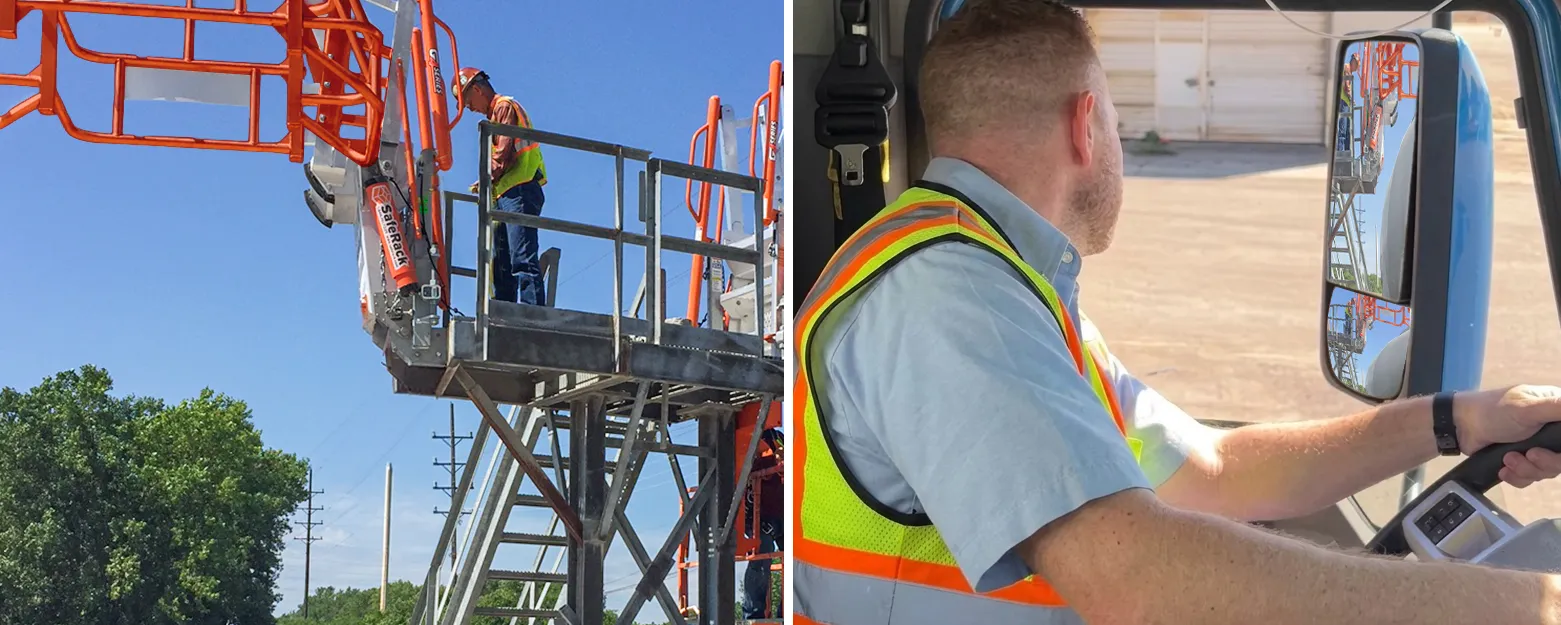
Hi‑vis safety orange improves job site safety because drivers see critical equipment sooner. That’s not just color preference—it’s a measurable difference in when a driver first notices the equipment and starts to react.
These structures are the “front door” to bulk loading operations, where liquids, powders, and granules are transferred to and from trucks and railcars.
A truck loading rack is a fixed platform and access system installed alongside the lanes where trucks park to load or unload. It typically includes a walkway or platform, a pivoting gangway that reaches the truck or railcar, and a safety cage or guardrail envelope that provides fall protection at the top of the vehicle. A MultiSpot Rack is a loading rack designed with multiple loading positions—several spots where trucks can pull in and be serviced—so a facility can handle more traffic without building separate racks for each lane.
Detection Distance and Reaction Time
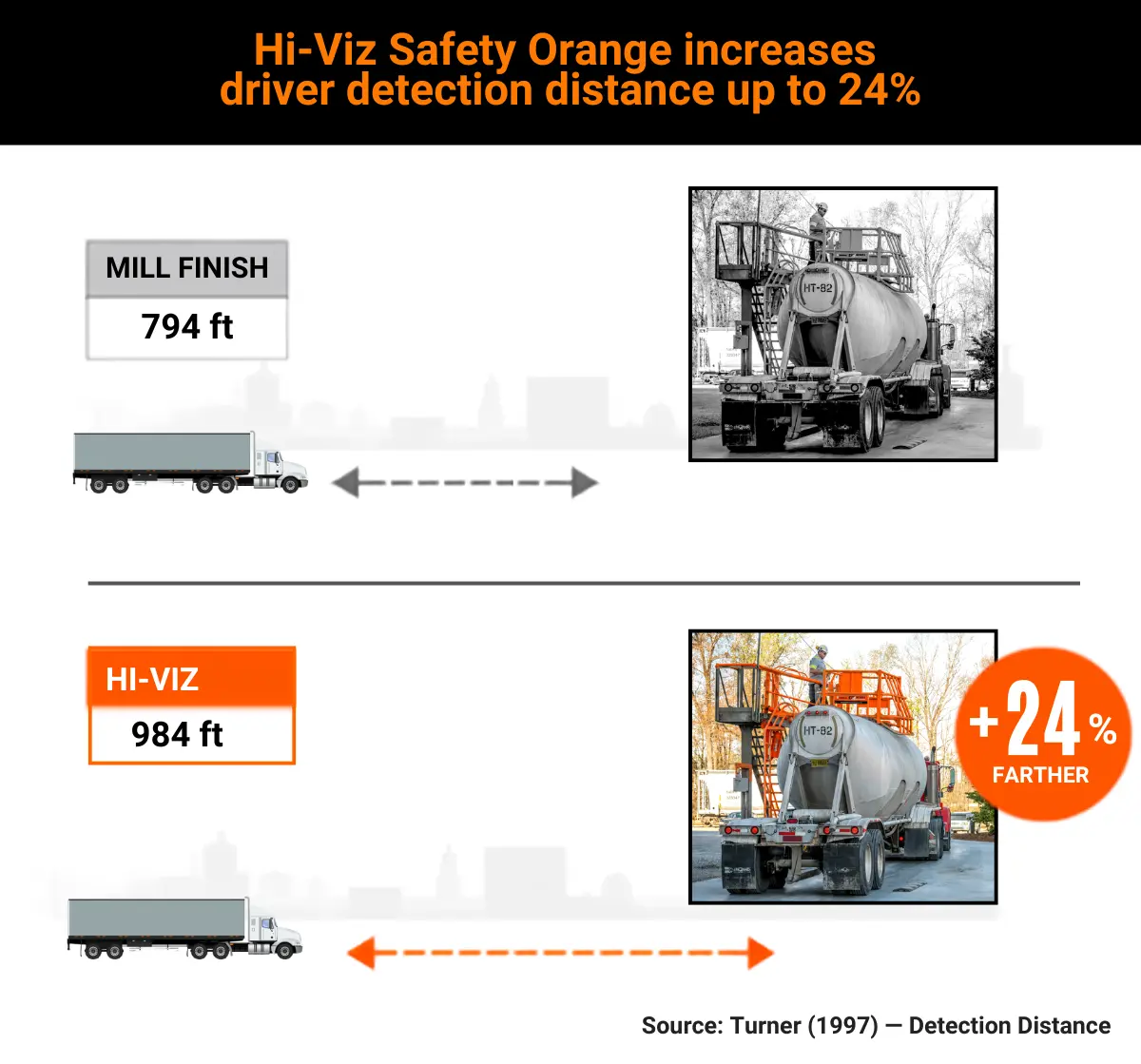
If you want to understand what high‑vis powder coating really does for safety, start with detection distance. Imagine a driver approaching a MultiSpot Rack with several loading positions. With a neutral finish, the cage might only register once the truck is already close—think of a rough average distance where gray metal finally separates from gray background. With high‑vis safety orange, that same structure is visible much earlier. In field comparisons, that gap can be as high as a 24 percent increase in detection distance.
That extra distance is critical, because more distance means more time. Instead of dropping speed and checking alignment at the last moment, drivers see the access point sooner, ease into the approach, and use the equipment itself as their “aim point.” On busy sites where you have rotating carriers, contractors who only visit a couple of times a year, seasonal drivers coming in for a short contract, you don’t always have deep familiarity to lean on. High‑visibility finishes give them a clearer reference, sooner, without needing an extra briefing.
From a safety perspective, that’s the real value: you’re not changing how the equipment works, you’re changing when awareness of it enters the driver’s brain.
Peripheral Vision in the Real World
In a perfect world, every driver would approach a rack with full attention focused on one thing. In the real world, that’s not how it works. On any given workday, a driver is juggling mirrors, watching spotters, listening to radio traffic, reading scale indicators, and thinking about the next stop. The cage or gangway they’re headed toward is one more piece of information in an already crowded picture.
Under those conditions, equipment is often first picked up in peripheral vision, not the center of the driver’s gaze. High‑vis color is built for that channel. Bright safety orange tends to “jump” in the corner of the eye whether it’s laid against pipework, a dark tank shell, green vegetation, or concrete. Mill‑finish gray doesn’t. It sits flat in the scene until the driver is right on top of it.
When you’re relying on peripheral awareness to catch hazards early, that difference isn’t cosmetic. It’s the line between “I saw it in time” and “I didn’t really see it until I was there.”
Equipment Damage and Early Drive‑Offs
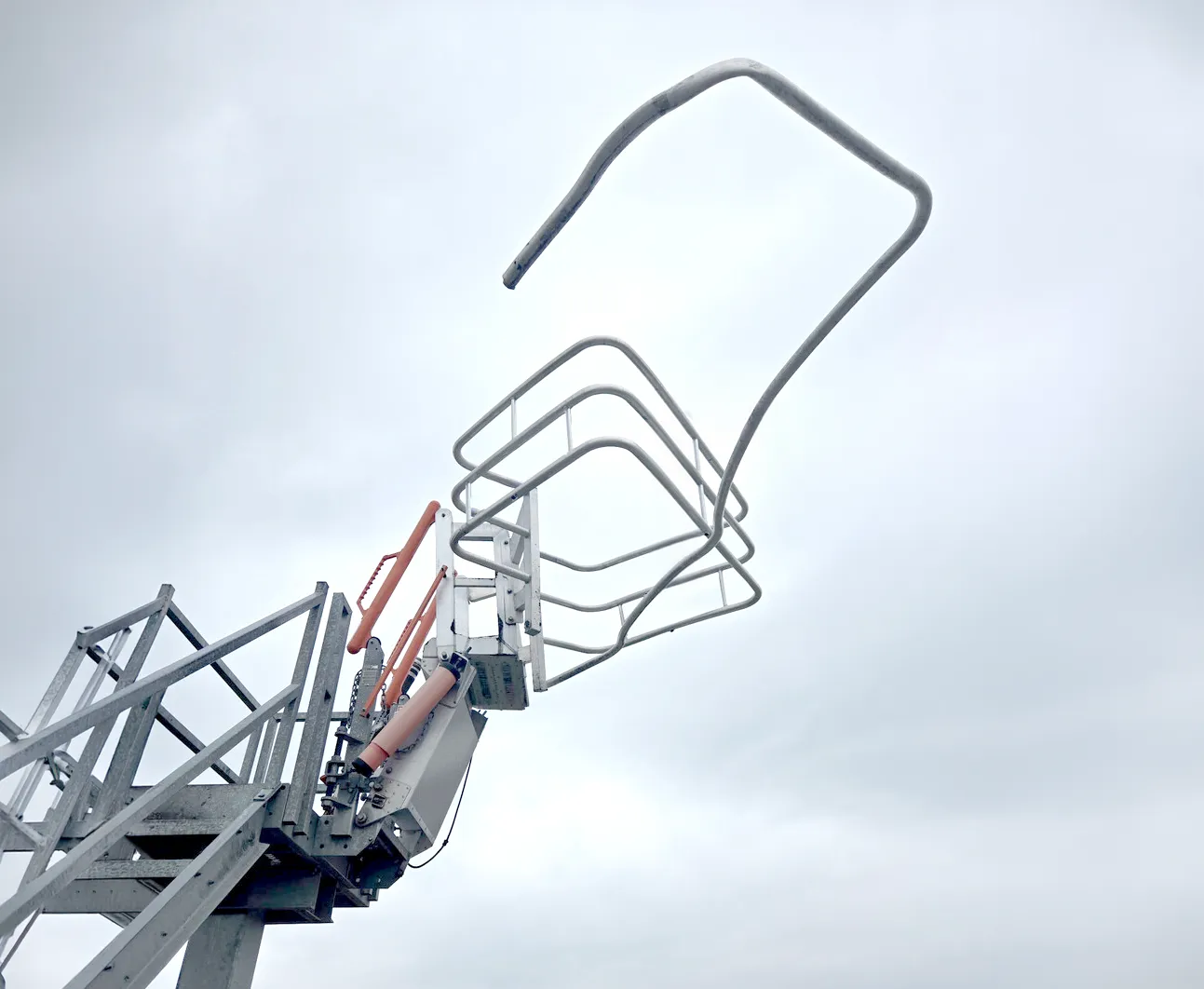
The conversation about visibility isn’t just about protecting people; it’s also about protecting equipment and product. One of the recurring risks around loading racks is the early drive‑off: a truck moving before the gangway is fully stored or before hoses and connections are clear. In the best case, that leads to damaged equipment and unplanned downtime. In the worst case, it can create a serious safety incident.
When gangways and safety cages are low‑contrast gray, a partially deployed gangway can visually disappear into the tank shell and rack structure. A driver glancing up may not register that something is still in the operating envelope. When those same components are finished in high‑vis orange, it’s much harder to miss a gangway that’s out of place. The color itself flags that “something is in the way,” reducing the chance of accidental contact, bent equipment, or a true drive‑off.
SafeRack has explored this connection between visibility and equipment damage in more detail in its materials on drive‑offs and gangway position. Read more in Drive‑Off Incidents: The Hidden Costs .
The Behavioral Power of Orange
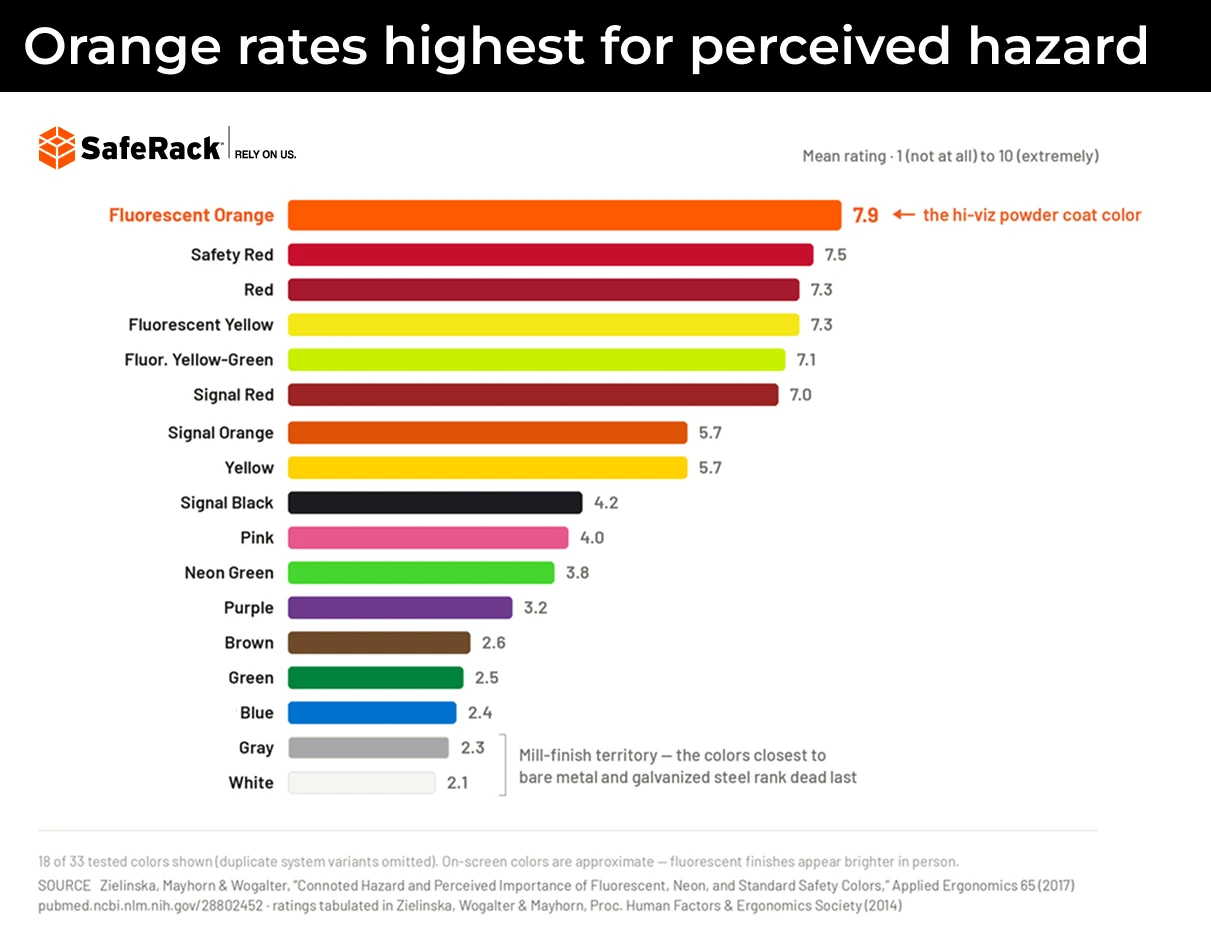
There’s another layer to high‑vis color that we don’t often consider: site awareness. Drivers have seen safety orange their entire careers. Cones, barricades, work‑zone signs, flaggers’ vests—orange is the color that basically says, “Something is happening here. Pay attention.”
By the time a driver backs under a rack, that association is baked in. When a cage, gangway, or guardrail is finished in safety orange, it taps into that learned response. Drivers start to ease off the throttle and scan the area almost automatically. They might not consciously think, “That’s a hazard marker,” but their behavior shifts just the same.
Neutral finishes don’t have that effect. They’re invisible emotionally as well as visually. With high‑vis powder coating, the equipment itself becomes part of the site’s behavioral coaching, not just a passive structure.
Working in Dust, Dusk, and Mixed Backgrounds
When people picture a worksite, they often think of clear weather and evenly lit equipment. Actual operating conditions are rarely that clean. Loading racks see foggy mornings, flat gray winter light, late‑day sun, and everything in between. Dust and particulate hang in the air. Vegetation, tank farms, and buildings all crowd into the same line of sight.
Neutral equipment finishes struggle in that environment. When everything around a cage is gray or muted, and the cage itself is coated in the same layer of dust, the structure melts into its background. High‑visibility powder coats are built to maintain contrast under those conditions. They seal the substrate, hold color longer under UV, and stay visually “loud” even when they’re not perfectly clean.
That’s especially important for sites that run heavily at dawn and dusk. Those are the times when shadows deepen, contrast drops, and human vision is already working harder. A high‑vis cage or gangway becomes a landmark in that low‑contrast landscape, helping drivers orient themselves long before they’re nose‑to‑nose with the equipment.
Making People Easier to See
High‑vis coating doesn’t just help you see metal; it helps you see people. Many access systems put operators inside a guardrail envelope or cage while they work. Stand 50 yards away and look toward a neutral‑finish installation. Depending on the lighting, it can be surprisingly hard to tell whether anyone is in that space without getting closer.
From a supervisor’s perspective, that’s extra walking and extra risk. From a driver’s perspective, it means making decisions without a clear picture of who might be in harm’s way.
When the equipment frame is high‑vis orange, the operator is effectively outlined against the structure. It’s easier to see that a position is occupied, to recognize that work is in progress, and to avoid assuming a spot is clear when it isn’t. Better visibility into “who is where” improves situational awareness and cuts down on the kind of misunderstandings that lead to near‑misses. You can see real world examples in our loading section.
Alignment, Spotting, and Equipment Position
Alignment and spotting might not sound dramatic on paper, but they’re where a lot of awkward moments happen in the field. Truck spotting in this context simply means positioning a truck correctly under the rack so the gangway, safety cage, and loading equipment line up with the hatch or connection point.
On a MultiSpot Rack with three or more positions, neutral‑finish equipment can make it tough for a driver to know exactly which spot they’re lining up to. A half‑truck‑length off can mean stopping in the wrong place or having to make last‑second adjustments.
High‑vis powder coating gives each access point a clear visual anchor. The driver can pick the cage or gangway as their target from farther out and “drive to the orange” rather than guessing where the neutral structure begins and ends. The same logic applies when equipment isn’t properly stored. A gangway left partially down in safety orange looks like an obvious problem from the yard; the same gangway in mill finish can blend into the tank shell or rack until it’s directly in the travel path.
For a deeper dive into spotting and equipment layout, see Essential Steps for Safe and Efficient Truck Spotting and the Truck Spotting with Kenny and Ray podcast.
Aligning with the Broader Safety Picture
High‑visibility orange doesn’t live only on industrial equipment. It’s woven into the broader safety language across highways, rail yards, and construction sites. Temporary traffic control devices, work‑zone signs, and high‑vis apparel all rely on bright base colors and reflective elements to make people and hazards easier to see under mixed conditions.
Bringing that same logic onto a loading rack or terminal is a natural extension. When the vest, the cone, and the guardrail are all part of one visual system, drivers don’t have to re‑learn what color means every time they cross a property line. The message is consistent: if it’s bright and orange, it’s something to respect.
From Upgrade to Default
You still see high‑vis powder coating listed as an “optional upgrade” in a lot of spec sheets. On paper, that makes sense. It’s an add‑on. In practice, when you look at how much it improves visibility, how early it enters peripheral awareness, how it helps prevent equipment damage and early drive‑offs, and how directly it influences driver behavior, it starts to look more like something that should be the default.
A better way to frame the decision is to ask, “Where can we honestly justify not using high‑vis?” On a controlled, indoor, single‑driver installation with stable lighting and a tight fleet, a neutral finish might be acceptable. Out in the real world—outdoor racks, high‑turnover driver pools, changing light, complex backgrounds—the case for high‑visibility powder coating on critical access and fall‑protection equipment is hard to argue against.
At some point, color stops being just about how equipment looks. It becomes part of how the site keeps people safe, protects equipment, and gives everyone the margin they need to make good decisions.
Related Resources
Essential Steps for Safe and Efficient Truck Spotting
SafeRack’s truck spotting guide covers how to position vehicles at loading racks to reduce back‑overs, equipment damage, and mis‑spotted hatches.
Truck Spotting with Kenny and Ray – The Podcast
Industry specialists Kenny Rogers and Ray Evans discuss truck spotting challenges in cement, aggregate, and bulk chemical loading, and how equipment layout and safety cages factor in.
Truck Spotting Glossary and Definitions
A quick reference for terms like truck spotting, MultiSpot Racks, hatch access, and drive‑offs.
Drive‑Off Incidents and Their Hidden Costs
Explores how early drive‑offs damage equipment, slow operations, and affect safety records, and how visibility and layout help prevent them.
Building a Worksite Safety Record to Be Proud Of
Practical guidance on improving overall safety performance across loading racks and access equipment.
Cement Gangway Truck Loading Installations
Real‑world examples of high‑visibility gangways and safety cages in cement loading applications.
FAQs
High‑visibility powder coating makes critical equipment easier to see from a distance and in peripheral vision. Drivers recognize cages, gangways, and loading racks sooner, which improves alignment, reduces mis‑spotting, and helps prevent early drive‑offs and equipment contact.
In this context, “high‑visibility” refers to bright, saturated colors—typically safety orange—that create strong contrast against common industrial backgrounds like gray tanks, pipe racks, and concrete. The goal is to make equipment stand out in real operating conditions, including dust, dawn/dusk lighting, and visually busy environments.
Standard mill‑finish aluminum or gray steel tends to blend into most industrial settings, especially once dust and grime build up. High‑vis safety orange cuts through that visual noise. Drivers can pick out an orange cage or gangway from farther away and in their peripheral vision, while neutral equipment often disappears until they’re right on top of it.
A MultiSpot Rack is a truck loading rack designed with multiple loading positions. Instead of building separate racks, facilities can pull several trucks under one structure and service them at different “spots,” which increases throughput but also makes clear visual cues even more important for safe alignment and spotting.
Truck spotting—positioning vehicles correctly under the rack—ensures gangways, safety cages, and loading equipment line up with hatches and connection points. Poor spotting can create unsafe gaps, cause equipment damage, slow down operations, and increase the risk of falls and drive‑offs.
When access equipment at a loading rack is high‑vis, each position becomes a clearer visual target. Drivers can “drive to the orange” instead of guessing where neutral equipment begins and ends, which reduces mis‑spotted hatches, awkward last‑second corrections, and the chance of contacting equipment that’s still in the operating envelope.
Yes. Early drive‑offs and mis‑spots can cause gangways and cages to hit vehicles or absorb unintended forces. High‑vis finishes make it much easier to see if a gangway is still down or if a truck is out of position. That extra visual clarity helps drivers and operators avoid contact that bends equipment, shortens its lifespan, and creates unsafe conditions.
It helps both. Drivers benefit from clearer landmarks for alignment and spotting. Operators benefit because high‑vis frames make it easier for supervisors and ground personnel to see that a position is occupied and that work is in progress, which improves situational awareness and communication around the rack.
It has the biggest impact outdoors and in complex visual environments—multi‑lane yards, terminals, and plants with mixed structures and changing light. In controlled, indoor environments with stable lighting and a dedicated driver pool, neutral finishes may be acceptable. Once you introduce rotating drivers, higher traffic, and variable light, high‑vis finishes become much more valuable.
SafeRack’s post “Essential Steps for Safe and Efficient Truck Spotting” and the “Truck Spotting with Kenny and Ray” podcast offer detailed guidance on spotting techniques, equipment layout, and how to align vehicles safely at bulk loading racks.