


Truck Spill Containment System Pads
Categories: Spill Containment Aerospace & Aviation Aerospace
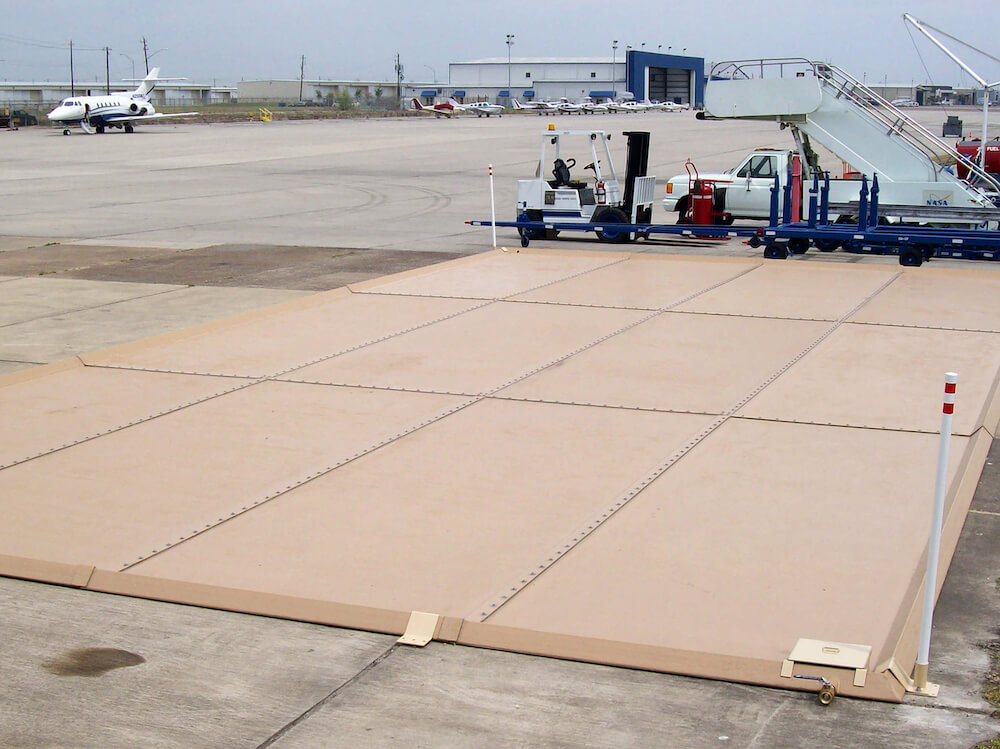
An Installed Airport Spill Containment Pad
Nowhere is truck spill containment more necessary than at an airport, where aircraft refueling involves multiple moving parts, k, elevated fuel ports, and human interaction that all increase the risk of accidental spills. Truck spill containment pads are essential safety systems designed to capture and control fuel or chemical leaks during transfer operations from trucks to aircraft, helping prevent environmental damage, maintain compliance, and ensure safe, uninterrupted fueling operations in complex airport environments.
What are truck spill containment pads?
Truck spill containment pads are portable or fixed secondary containment systems placed beneath fuel trucks during loading or unloading operations. Their primary purpose is to capture and contain accidental discharges of hazardous liquids such as AVGAS and Jet-A fuel.
These truck spill containment pads help prevent spills from spreading into surrounding areas, protecting both personnel and the environment while ensuring controlled fueling operations.
Importance of truck spill containment pads
In airport fueling operations, even a small spill can lead to major operational delays and regulatory issues. Truck spill containment pads reduce these risks by providing immediate containment of fuel leaks or accidental discharges.
They also help facilities comply with EPA and SPCC regulations by ensuring that proper spill control measures are in place. Without truck spill containment pads, cleanup procedures become more complex, time-consuming, and costly.
How truck spill containment pads work
Truck spill containment pads are positioned beneath fueling trucks or aircraft refueling points. When a spill occurs, the pad captures and contains the liquid within its controlled surface area, preventing it from spreading. This allows cleanup crews to manage the incident more effectively while reducing environmental impact and maintaining safer operational conditions during fueling activities.
Key features
- Portable and easy-to-position design
- Fast installation with minimal site preparation
- Immediate operational readiness
- Designed for aviation fuel handling environments
- Supports EPA SPCC compliance requirements
- Effective containment of hazardous fuel spills
These features make truck spill containment pads suitable for demanding airport and industrial fueling applications.
Applications
- Airport fueling stations
- Aircraft refueling zones
- Fuel truck loading and unloading areas
- Aviation maintenance facilities
- Fixed-base operator (FBO) operations
In these environments, truck spill containment pads ensure safe and controlled fuel handling operations.
Role in airport safety systems
In modern aviation fuel management, truck spill containment pads are a key component of spill prevention strategies. They provide a proactive solution to reduce risk before incidents escalate. By integrating truck spill containment pads into airport operations, facilities improve safety, reduce environmental impact, and strengthen compliance with regulatory requirements.
What are truck spill containment pads used for?
They are used to contain accidental fuel or chemical spills during aircraft refueling and truck loading operations.
How do truck spill containment pads improve safety?
They improve safety by capturing spills immediately, preventing fuel from spreading and reducing environmental hazards.
Where are truck spill containment pads commonly used?
They are commonly used in airports, fueling stations, aircraft refueling areas, and industrial fuel handling sites.
Are truck spill containment pads required by regulations?
They support compliance with EPA and SPCC regulations for spill prevention and environmental protection.
What fuels do truck spill containment pads handle?
They are designed for hazardous fuels such as AVGAS and Jet-A used in aviation operations.