


A gate valve, also known as a sluice valve, is a type of linear motion valve use to start or stop the flow of liquid in a pipeline. In wastewater treatment plants and oil and gas industries, The are designe to be either fully open or completely closed, permitting a full flow of liquid or effluents in either direction through the pipeline. These valves mounte in pipelines as isolating valves and should not be use for flow control or regulation. The primary advantage of a it is its ability to provide minimal pressure loss and a free bore (full port) when fully open. A gate valve may also be known as a multiturn valve because a threade stem provides the valve’s moving portion in the middle of the yoke.
For facilities handling bulk liquids, bulk chemical plants rely on proper valve selection for safe pipeline isolation.
How a Gate Valve Works
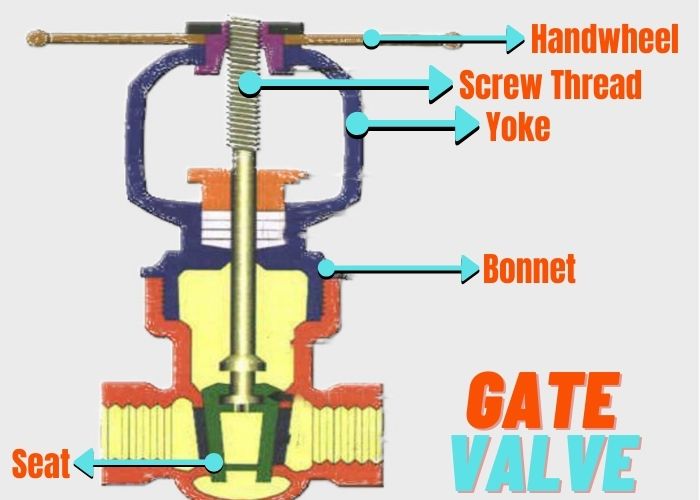
its operates by lifting a rectangular or circular gate out of the path of the fluid flow. The valve mechanism consists of several key components:
- Valve body: The outer casing that connects to the pipeline
- Gate (disc): The closing element that moves up and down
- Stem: A threaded rod that raises and lowers the gate
- Yoke: The support structure holding the stem mechanism
- Handwheel or actuator: The operator input that turns the stem
When the handwheel is turned, the threaded stem rotates, lifting the gate completely out of the flow path. In the fully open position, the creates a smooth, unobstructed bore that matches the pipeline diameter, resulting in very low pressure drop. Because the gate moves linearly (up and down) rather than rotationally, these valves are called multiturn valves.
Important operating rule: It should never be use in a partially open position. When the gate is only partially raised, fluid flows past the gate at high velocity, causing vibration, erosion, and damage to the gate and seating surfaces. This is why the are classified as isolating valves, not control or regulating valves.
For safe loading operations, truck loading systems often incorporate gate valves for pipeline isolation at loading racks.
Types of Gate Valves
Its manufacture in two primary configurations, each suited for different applications.
Parallel Gate Valves:
Parallel use a flat gate positioned between two parallel seats. The gate slides vertically between these seats, creating a seal when fully closed. A popular variant is the knife gate valve, which features a sharp edge on the bottom of the gate. The sharp edge can cut through thick liquids, slurries, and viscous media, making knife gate ideal for wastewater, pulp and paper, and mining applications.
Wedge-Shaped Gate Valves:
Wedge-shaped use a gate that is wedge-shaped (tapered) and two sloping seats. The wedge design creates a tight mechanical seal when the gate is driven down between the seats. As the wedge gate lowers, it pushes outward against the seats, creating higher sealing pressure. This design compensates for thermal expansion and wear over time. Wedge gate valves are commonly use in oil and gas, petroleum refining, and high-temperature applications.
For processing applications, loading arms incorporate gate valves for flow isolation. Swivel joints work alongside gate valves in loading arm assemblies to provide both articulation and flow isolation.
Applications
They are use across numerous industrial sectors where reliable isolation is required:
- Wastewater treatment: Isolating sections of effluent pipelines for maintenance
- Oil and gas pipelines: Blocking flow in transmission and distribution lines
- Petroleum refineries: Isolating process units and tank farm connections
- Chemical processing: Isolating reactors, storage tanks, and transfer lines
- Power generation: Cooling water systems and steam isolation
- Pulp and paper mills: Handling black liquor, white liquor, and green liquor flows
- Mining and minerals: Slurry pipelines and tailings lines
- Pharmaceutical: Sanitary isolation of processing lines
- Food and beverage: Sanitary gate valves for edible liquids
For loading rack applications, loading racks and skids incorporate gate valves at multiple points. Railcar loading systems also use for isolation during bulk transfers.
Benefits and Limitations
Benefits:
- Minimal pressure loss: Full bore design creates no flow obstruction when fully open
- Bi-directional flow: Permits full flow of liquid in either direction in a pipeline
- Tight sealing: Provides reliable shutoff when fully closed
- Simple operation: Multiturn design allows precise gate positioning
- Wide size range: Available from small diameters to large mainline sizes
- Durable construction: Suitable for high pressure and high temperature applications
Limitations:
- Not for throttling: Should never be used for flow control or regulation
- Slow operation: Multiturn mechanism requires many handle rotations
- Seat damage risk: Partially open position causes erosion and vibration damage
- Large installation footprint: Requires more vertical space than quarter-turn valves
- Not for frequent cycling: Best suited for infrequent isolation, not daily operation
Importance of Proper Selection:
Using a gate valve for throttling or regulation will quickly destroy the gate and seats, leading to leaks and unplanned downtime. Facilities must specify gate valves only for isolating applications and use globe valves, ball valves, or butterfly valves for flow control. Breakaway couplings provide emergency flow isolation and work as a safety backup to gate valves in loading applications. Spill containment systems capture leaks from faulty gate valves.
Safety Considerations
it handling flammable liquids require additional safety measures. Grounding and monitoring systems prevent static discharge before operators touch gate valves. Overfill protection systems work to stop flow when tanks reach capacity.
A gate valve (also called a sluice valve) is use as an isolating valve to either fully start or fully stop flow in a pipeline. It is designe for fully open or completely closed positions and should never be use for flow control or regulation.
When a gate valve is partially open, fluid flows past the gate at high velocity, causing vibration, erosion, and mechanical damage to the gate and seating surfaces. This leads to premature valve failure and leaks. Gate valves are isolating valves only, not control valves.
Its use a flat gate between two parallel seats. The knife gate valve variant has a sharp edge to cut through thick slurries, ideal for pulp and paper and mining.
It is called a multiturn valve because a threaded stem provides the valve’s moving portion in the middle of the yoke. The operator must turn the handwheel many times to raise or lower the gate.