


A yoke is a critical component of a gate valve. It is a partition binding the actuating mechanism and the bonnet together. The provides the structural support that connects the valve’s moving parts to its stationary body. Without it, the valve actuator would have no stable platform to push against. In terms of construction, the must be powerful enough to resist forces, crank pressures, and torque produced by the actuator. This partition built strong because it handles all the stress of opening and closing the valve. You can tell which valves have yokes by the openings for moving the actuator links. For facilities that use gate valves in their operations, bulk chemical plants rely on yoke equipped valves for reliable flow isolation.
How Its Works
They works as the bridge between the valve body and the actuator. Here is how it functions:
- The connects to the bonnet at its bottom
- The actuator mounts to its top
- The valve stem passes through the center of the yoke
- The absorbs all actuator forces
- It keeps the stem perfectly aligned
Its attached to the top, which holds a stem nut, stem bushing. This nut carries the valve stem through it. When the actuator turns, they holds everything steady. For precision valve operation, metering systems work alongside equipped valves for accurate flow control.
Yoke Nut Explained
It is an important part of the assembly. Here is what you need to know about other names for yoke nut:
- T-nut
- Nipple nut
- House nut
What it does
- Internally threaded nut
- Connects to its stem
- Transfers motion from actuator to stem
How it works in a gate valve
- When the gate valve is rotated, the stem goes up or down through the valve
- The drives this motion
- It converts rotational force into linear movement
In globe valves, the two nuts are fixed in place, and the upper nut is rotated through the stem. This design is slightly different but uses the same principle. For petroleum refineries, yoke type gate valves are standard equipment on many process lines.
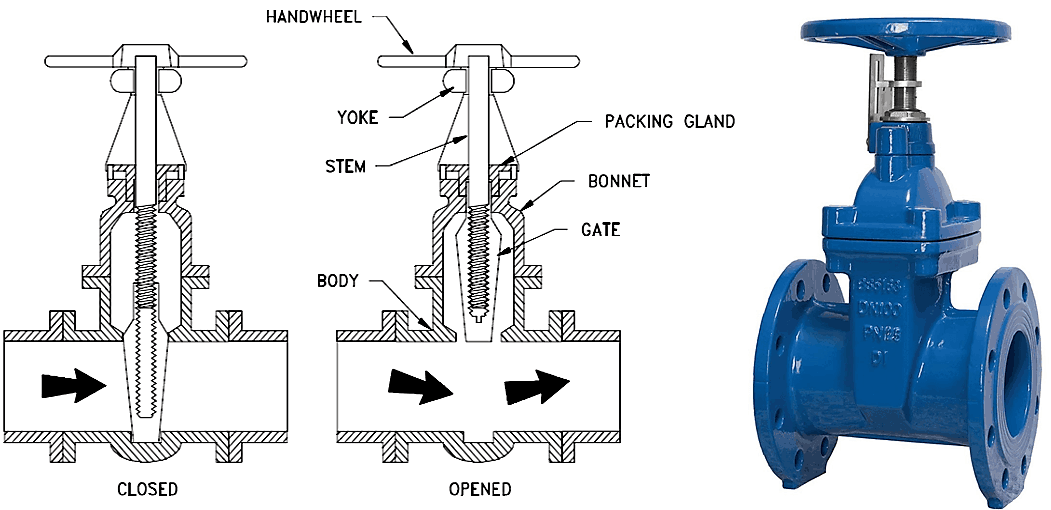
Parts of a Yoke Assembly
A complete assembly includes several components working together. Here are the main parts:
- Body: The main structural partition
- Yoke nut: Internally threaded nut at the top
- Stem nut: Holds the valve stem in position
- Stem bushing: Reduces friction on the stem
- Bbushing: Guides the stem through the yoke
- Mounting flange: Connects actuator to yoke
- Bonnet connection: Attaches to valve body
The must be powerful enough to resist all forces, crank pressures, and torque produced by the actuator. Each part plays a role in this strength. For oil and gas and pipelines assemblies on gate valves must withstand extreme pressures.
Where Yokes Are Use
The are found on many types of industrial valves. Here are the most common applications:
- Gate valves (rising stem type)
- Globe valves
- Large diameter ball valves (with gear operators)
- Control valves with diaphragm actuators
- Pressure relief valves
- Knife gate valves
- Sluice gates
You can tell which valves have yokes by the openings for moving the actuator links to the yoke. it is usually visible as the structural arms connecting the top of the valve to the actuator. For chemical processing, yoke type valves are preferred for their durability and ease of maintenance.
it is a partition binding the actuating mechanism and the bonnet together on a gate valve.
it is an internally threaded nut that connects the yoke to the valve stem and converts rotation into linear motion.
It is also called a T-nut, nipple nut, nut, or house nut.
They must resist forces, crank pressures, and torque produced by the actuator to keep the valve operating properly.