


Handrails Keep Metal Stairs Safe for Public and Commercial Use
Categories: Access Stairs Stairs & Work Platforms Industrial ErectaStep Facility
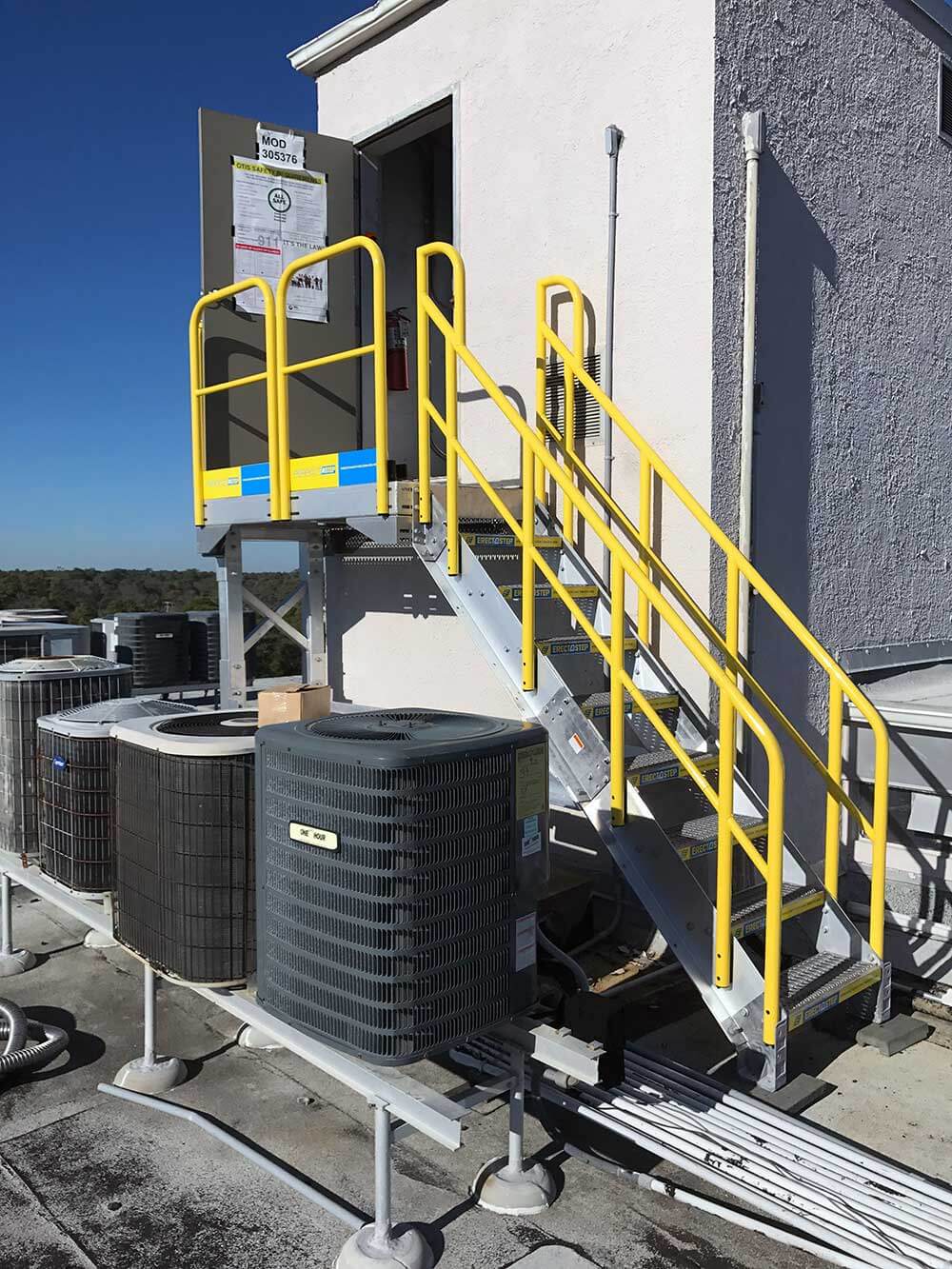
Elevator Shaft Electrical Room-Rooftop Installation in Myrtle Beach, SC
Safe access to elevated areas such as rooftops, electrical rooms, and maintenance platforms is essential in commercial and industrial environments. A commercial metal stair handrails system provides a durable and reliable solution, allowing workers to perform tasks such as inspections, equipment servicing, and emergency operations with greater safety and stability. Unlike ladders, these stair systems provide a secure, structured access point, making it easier to move tools and heavy equipment while reducing the risk of accidents. Integrated handrails provide continuous support during ascent and descent, ensuring better balance and control for workers operating in tight or elevated spaces.
By combining strong stair structures with protective handrails, these systems improve accessibility, enhance workplace safety, and support compliance with industry standards in demanding environments.
What are Commercial Metal Stair Handrails?
Commercial metal stair Handrails are structural safety systems installed alongside stairways to provide balance, support, and fall protection. These systems are typically integrated with metal stairs and platforms to create a complete access solution for elevated work areas. Designed using durable materials such as aluminum or steel, Commercial metal stair Handrails ensure stability and controlled movement when navigating stairs in industrial and commercial facilities.
Importance of Commercial Metal Stair Handrails
Working at height or on stairways presents significant risks, especially in environments where workers carry tools or equipment. Commercial metal stair handrails help reduce these risks by providing a secure support system that improves balance and minimizes the chance of slips and falls. They also play an important role in maintaining workplace safety and supporting compliance with OSHA, IBC, and ADA regulations cross different operational areas.
How Commercial Metal Stair Handrails Work
Commercial metal stair handrails are installed along stairways and access platforms to provide continuous support as workers move between levels. They function as both a guiding support and a protective barrier, helping maintain stability during movement. When integrated with modular stair systems, they enable safe and efficient access to elevated areas such as rooftop control rooms and equipment zones.
Key Features
- Durable metal construction for long-term use
- Integrated handrails for improved stability and safety
- Slip-resistant compatibility for safer movement
- Weather and corrosion-resistant materials
- Compliance with OSHA, IBC, and ADA standards
- Suitable for indoor and outdoor applications
OSHA, IBC, and ADA Handrail Codes
Handrail height is an important safety requirement in both commercial and industrial environments. OSHA and IBC regulations define standards to ensure safe stair access, while ADA guidelines focus on accessibility in public and shared spaces. Typically, handrails are required to be between 34 inches and 38 inches in height, depending on application and user needs. In certain cases, adjustments may be necessary to ensure safe access for different users. For accessibility, handrails on both sides of a stairway are often required. This ensures stability for all users, especially those with balance or mobility challenges, where a single-sided rail or wall support may not be sufficient.
Benefits and Applications of a Handrail
Handrails make going up and down stairs safer and more comfortable, especially for older adults and young children. People naturally look for something to hold onto when approaching a staircase, and handrails support this instinct by improving balance and reducing the risk of falls. If a step is missed or a trip occurs, handrails provide immediate support that can help prevent a serious accident. They also assist individuals with limited mobility by offering stability during movement and transfers, such as moving from a wheelchair to a ramp. In addition to everyday use, handrails help people regain balance after a slip and provide steady support for those with visual or mobility challenges. They are commonly used in a wide range of environments, including hospital corridors, sloped pathways, and outdoor trails, where stable guidance is essential for safe movement.
Commercial metal stair handrails are used in many industrial and commercial settings, including rooftop access systems, elevator shafts, electrical rooms, industrial maintenance platforms, commercial stairways, and equipment access areas. In all of these environments, they ensure safe, stable, and controlled movement across elevated access points.
Key Applications
- Rooftop access systems
- Elevator shafts and electrical rooms
- Industrial maintenance platforms
- Commercial building stairways
- Equipment access areas
Handrails Prevent Falls
Railings are an important safety feature, particularly on stairways and balconies. They provide support and stability to reduce the risk of falls. Therefore, it is essential to choose a material that is strong and durable. Structural aluminum is an effective choice for railings due to its high strength, tensile strength, and resistance to twisting and bending. It is also rust-proof and weather-resistant, making it suitable for outdoor applications. One of the key safety features of any building is the handrail. Handrails are required by code in many jurisdictions because they provide essential support for people moving through commercial and industrial properties. Compliance with handrail regulations is important, as failure to meet code requirements can result in penalties and legal liability in the event of an accident. For this reason, handrails are a critical part of maintaining a safe and compliant environment.
The ErectaStep installation shown above includes an eight-step platform leading to a structure housing the top of an elevator shaft. This system was selected to support safe and efficient access for maintenance activities such as electrical work, re-cabling, lubrication, and inspection.
What are Commercial metal stair Handrails used for?
Commercial metal stair Handrails are used to provide safe access to elevated machinery, control panels, and maintenance areas in industrial environments.
How do Commercial metal stair Handrails improve safety?
They improve safety by offering stable support and reducing the risk of slips, trips, and falls on stairways.
Where are Commercial metal stair Handrails commonly installed?
They are commonly installed in rooftop access systems, electrical rooms, elevator shafts, industrial platforms, and commercial buildings.
Are Commercial metal stair Handrails required by code?
Yes, OSHA, IBC, and ADA regulations require proper handrail installation for safe stairway access in many environments.
What material is best for Commercial metal stair Handrails?
Structural aluminum is commonly used due to its strength, corrosion resistance, and suitability for indoor and outdoor applications.