


34′ Stair Tower Installation
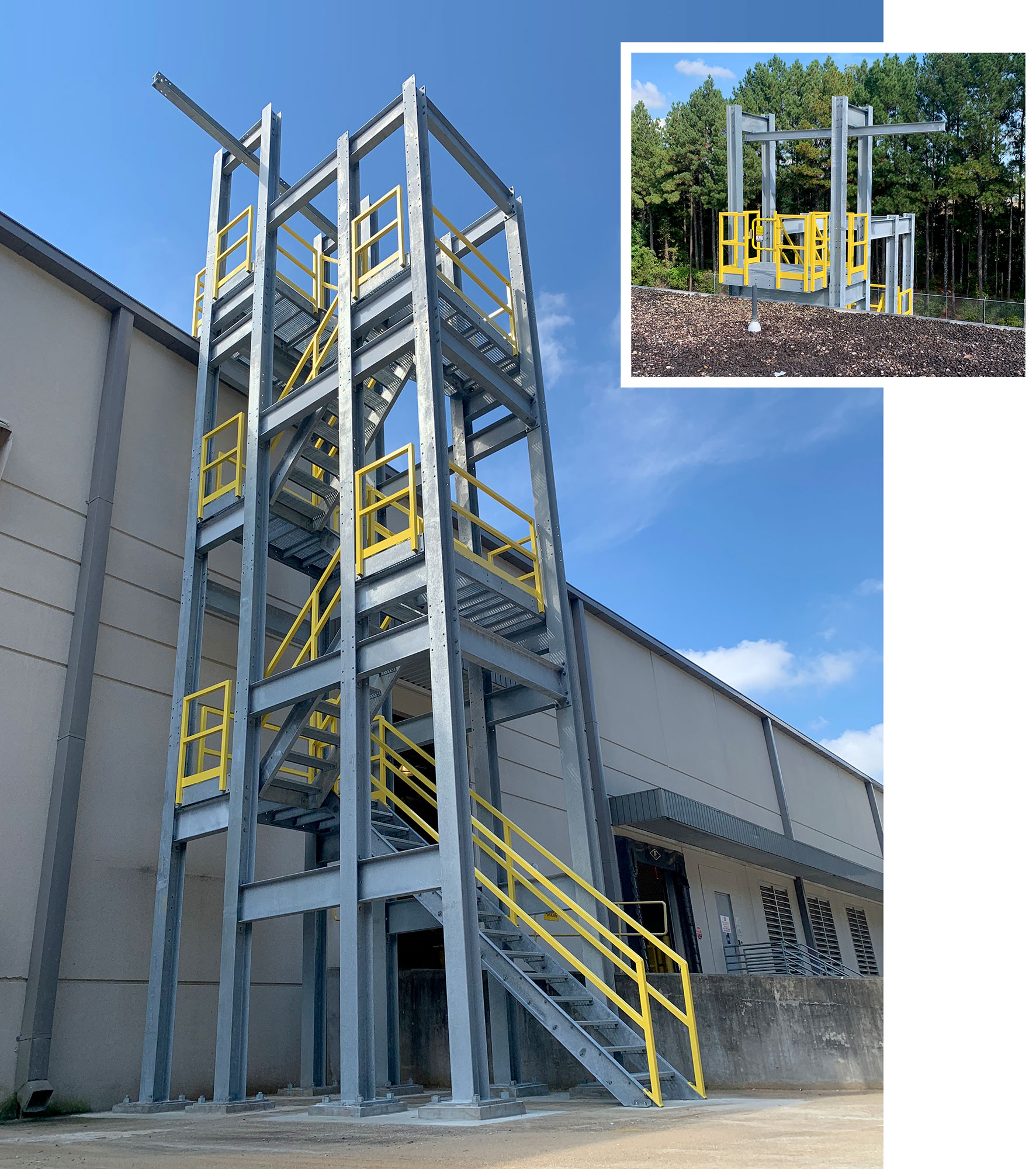
This is a customized ErectaStep stair tower installation. With a height of 34′ feet, this stair tower is for contractors, maintenance staff, and researchers to frequently access the roof at an HVAC R&D facility in Atlanta. This installation also includes a jib off to the side to safely hoist tools and small equipment up to the roof.
Stair tower installation provides a safe and efficient access solution for elevated work areas in industrial environments. Traditional ladders and temporary access systems often expose workers to fall hazards and limit productivity, especially in high-traffic or demanding job sites. Designed as a more stable alternative, stair tower installation incorporates safety features such as handrails and anti-slip surfaces to improve worker protection and reduce the risk of serious injuries. These systems also enhance operational efficiency by allowing multiple workers to move freely between levels and transport tools or materials with ease.
Widely used across industrial facilities, maintenance sites, and construction environments, stair tower installation supports safer access, minimizes downtime, and improves overall workflow in daily operations.
What is Stair Tower Installation?
Stair tower installation involves setting up a fixed, multi-level stair system that provides safe and reliable access to elevated work areas. These structures are commonly used in industrial environments where frequent movement between levels is required, offering a stable pathway for workers and equipment.
Importance of Stair Tower Installation
Working at height without proper access systems increases the risk of accidents, especially when relying on ladders or temporary structures. Stair tower installation provides a more secure solution by creating a controlled access route that enhances worker safety. Stair tower installation also improves efficiency by allowing multiple workers to move between levels smoothly, supporting better workflow in demanding operations.
Compliance and Standards
Stair tower installation in industrial environments is designed in accordance with OSHA Fixed Industrial Stair Regulations (1910.24), which define requirements for safe design, construction, and use. In commercial or public applications, systems may also follow International Building Code (IBC) standards.
Key Stair Tower Safety Features
To meet OSHA requirements and to ensure workplace safety, stair towers should be designed and constructed to incorporate certain key safety features.
Strength and Precision
OSHA regulations require stair towers to be designed to carry a load that is 5 times greater than the anticipated load, with a minimum load of 1,000 pounds. Moreover, handrails and guardrails must be able to withstand at least 200 pounds of pressure applied in all directions. Stairs must be a minimum of 22 inches wide and tread measurements are dictated by the angle of the stairway rise. For instance, a 45-degree stairway must offer a minimum rise and tread of 8.75 inches each. ErectaStep stair towers are made to precise specifications using high-grade aluminum. We use patented design processes that incorporate durable powder-coated handrails and laser-cutting technology to ensure superior strength, durability, and quality.
Slip Resistant
OHSA 1926 provides that slippery conditions on stairways must be eliminated “before the stairways are used to reach other levels.” ErectaStep stair towers feature anti-slip surfaces built into every stair tread and platform to ensure the highest level of safety and compliance.
Handrails and Landings
In addition to outward pressure requirements, handrails must meet certain height requirements. OSHA requires that the top rail be at least 42 inches in height while the handrail must be between 30 and 38 inches in height – measured from the leading edge of the stair tread to the top surface of the rail. OSHA 1917.120(b)(2) states that stair landings must offer at least 20 inches in depth. If a door or gate opens on the stairway there must be a landing platform and the door swing cannot reduce the effective standing area on the landing to less than 18” in depth. ErectaStep stair towers incorporate railings, handrails, and landings that comply with OSHA specifications to maximize worker safety and productivity.
Stair Tower Benefits
A stair tower installation provides significant safety and operational advantages for industrial workplaces. It improves worker safety by offering stable access to elevated areas and reduces dependency on ladders.
- Provides safe and stable access to elevated work platforms
- Reduces reliance on ladders and minimizes fall risks
- Improves worker mobility and efficiency on-site
- Supports faster movement of materials to elevated areas
- Can be customized for different heights and space constraints
- Suitable for indoor and outdoor industrial environments
- Features anti-slip surfaces for improved safety
- Includes sturdy handrails for secure movement
- Supports emergency access and evacuation routes
- Designed for quick installation with minimal disruption
- Built for long-term industrial durability
- Supports OSHA compliance requirements
This makes stair tower installation a reliable solution for improving safety, efficiency, and compliance across industrial operations.
ErectaStep: Prefabricated and Custom Stair Tower Solutions
ErectaStep offers a full line of OSHA-compliant industrial metal stairs and maintenance access platforms. These solutions are not only cost-effective but are easy to assemble. Prefabricated metal stairs bolt together in a snap without the need for welding or special tools. ErectaStep also offers IBC compliant commercial prefabricated metal staircases.
Know the difference between OSHA and IBC compliance. ErectaStep also makes it easy to design a custom stair tower. We utilize state-of-the-art tools that will provide you with custom detailed drawings and quotes in a matter of minutes. For more complicated applications, our experienced team will work with you to design the perfect solution.
Our team recently completed this design, build, and installation of a 34’ tall PSTEP stair tower system at an R&D lab facility located in Atlanta, Georgia. The lab sought a safe and efficient solution that would give workers access to the roof to service HVAC equipment and perform a broad range of weekly tasks. The stair tower allows maintenance staff and contractors to access the roof without using ladder access through the roof and also makes it simple to transport tools and materials safely. Contact our team today to discuss the perfect prefabricated or custom OSHA-compliant metal stair tower for your organization.