


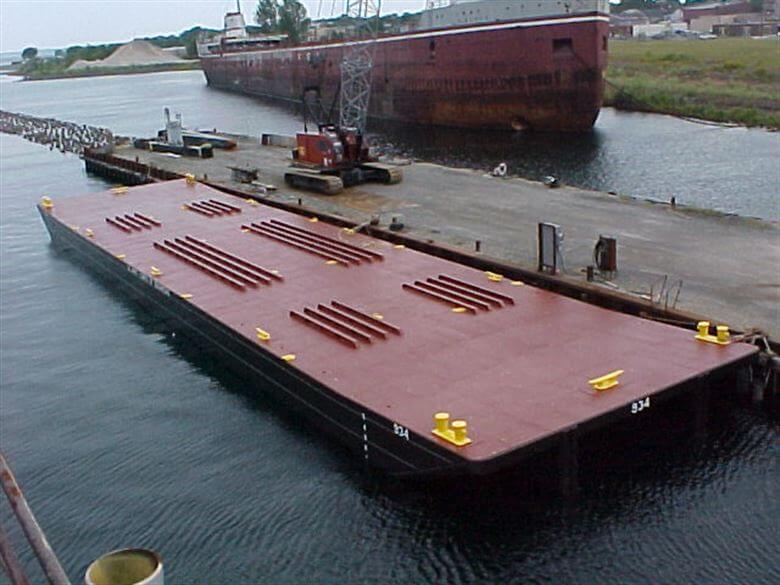
It is not surprising that OSHA has quite a bit to say about safety conditions on barges. The use of a maritime gangway and barges crosses over into many industries. Any operation that involves loading and unloading in a maritime environment will at some time have a barge in the mix. Deck barge safety is essential for protecting workers in these challenging conditions. Essentially, barges are large floating work platforms. They are used extensively in maritime construction projects that involve dredging and pile driving, as well as in maritime cargo operations. The need for excellent deck barge safety is critical because trips, slips, and falls are the major causes of injuries in the maritime environment. If your facility works with barges, you need marine gangways to provide safe passage from dock to barge.
Hazards on Deck Barges
Deck barge safety addresses many unique hazards. Here are the most common dangers:
- Surfaces on barges are wet and slippery
- Moving equipment creates struck-by hazards
- Barges rise and fall with tides and waves
- Improper footwear reduces traction
- Loud noise limits communication
- Poor fall protection procedures increase risk
Types of Falls on Barges
There are several ways workers can fall on barges. Here are the main types:
Elevated falls
- Falls from stairs and ladders
- Falls from onboard equipment
- Falls from cargo loads
Same-level falls
- Slips on wet decks
- Trips over equipment or lines
- Falls due to sudden barge movement
Hole-related falls
- Falls through holes in the deck
- Falls into uncovered hatches
- Falls through damaged deck plates
Injuries due to falls from stairs, ladders, and onboard equipment are common. Falls through holes in the deck or uncovered hatches are especially dangerous. Elevated falls can happen on stairs, equipment, ladders, and holes in decks with uncovered hatches. For bulk chemical plants, deck barge safety is important when receiving bulk liquids by barge.
OSHA Recommendations for Deck Barge Safety
When on a barge, OSHA recommends the following deck barge safety practices:
- Walk at normal speed
- Keep your hands out of your pockets
- Slow down when moving onto a different surface
- Do not run or make sharp turns
- Minimize stopping short
- Walk with even more care on icy decks
- Look ahead as you step
All of these OSHA suggestions are good common sense. Careful attention to all the details is in your best interest when working in a maritime environment or on any maritime gangway. For oil and gas facilities with barge access, following OSHA’s deck barge safety guidelines prevents injuries.
Safe Crossing Procedures
Deck barge safety starts with how you move between dock and barge. Here are key procedures:
- Avoid the temptation to jump from one barge to another
- Use a marine gangway with safety handrails
- Face the gangway when crossing
- Keep one hand on the handrail
- Carry nothing in your hands while crossing
- Wait for the barge to stabilize before stepping off
An immediate safety solution that should be put in place is an industrial-grade maritime gangway to allow safe passage from the barge to the dock or another ship. Deck barge safety depends on having the right equipment. For marine terminals, deck barge safety is a daily concern for all workers.
Maritime Gangway Requirements
A proper maritime gangway is essential for deck barge safety. Here is what to look for:
- Made from high-grade metal or aluminum
- Non-slip surface built into the walking surface
- Corrosion resistant for saltwater environments
- Safety handrails on both sides
- Adequate width for safe passing
- Proper weight capacity for workers and equipment
- Secure attachment at both ends
A modern industrial-grade maritime gangway is usually made from high-grade metal or aluminum with a non-slip surface built into it. These gangways are corrosion resistant and usually have safety handrails that create a safe crossover. Whenever you need to cross from a barge to a dock, marine gangways provide the safety you need. Safety cages add extra protection for workers on deck barge safety gangways.
Fall Protection on Deck Barges
Deck barge safety requires proper fall protection. Here are key measures:
- Use fall protection systems when working at height
- Install safety gates at deck openings
- Provide guardrail systems around edges
- Use body harnesses for high-risk tasks
- Cover all holes and hatches when not in use
If you need to get to the top of an on-deck cargo load, use a ladder with firm support. Do not walk at the edge of the deck if the barge does not have safety handrails. Safety barriers should be in place. For loading platforms, deck barge safety requires stable access to barges at all tide levels.
Footwear and Personal Protective Equipment
Proper footwear is critical for deck barge safety. Here is what OSHA recommends:
- Work boots that are waterproof
- Deep non-slip sole for wet surfaces
- Good ankle support
- Steel toe protection where needed
Other PPE for barge work
- Life jackets or personal flotation devices
- Safety headlamps for reduced visibility
- Hearing protection for loud equipment
- High-visibility clothing
Work boots that are waterproof and have a deep non-slip sole work best on wet surfaces. In situations where there is reduced visibility, add more illumination. Wearing a safety headlamp is a good idea for deck barge safety. For railcar gangways, similar safety principles apply for footwear and fall protection.
Walking Safely on Wet Decks
Deck barge safety requires special attention when walking on wet surfaces. Here are tips:
- Walk at normal speed, not too fast or too slow
- Keep your hands out of your pockets for balance
- Slow down when moving onto a different surface
- Do not run, make sharp turns, or stop short
- Look ahead and plan your path
- Avoid stepping on hatch covers
The need for excellent deck barge safety includes walking carefully on wet, slippery surfaces. For YELLOWGATE safety gates, these products help prevent falls at access points on barges. Work platforms provide stable areas for workers on barges.
Lighting and Visibility
Poor visibility is a major factor in barge accidents. Here is how to improve deck barge safety:
- Add portable lighting to dark areas
- Use headlamps for hands-free illumination
- Install permanent lighting on frequently used barges
- Keep pathways well lit at night
- Mark hazards with reflective tape
A Saferack maritime gangway gives your employees the safety they need when crossing from a dock to a barge or a ship. Deck barge safety starts with seeing where you are going. For loading arms, proper lighting is also essential for safe barge loading operations. Truck loading facilities can apply similar lighting principles for night operations.
Deck barge safety covers OSHA guidelines and practices for preventing falls, slips, and trips on barges in maritime environments.
Main hazards include wet slippery decks, rising and falling barge movement, uncovered hatches, and improper fall protection.
Use a marine gangway with safety handrails, face forward, keep one hand on the rail, and never jump between barge and dock.
Work boots that are waterproof with a deep non-slip sole work best on wet barge surfaces.