





Loading Dock Height Requirements: Complete Guide for Every Truck Type
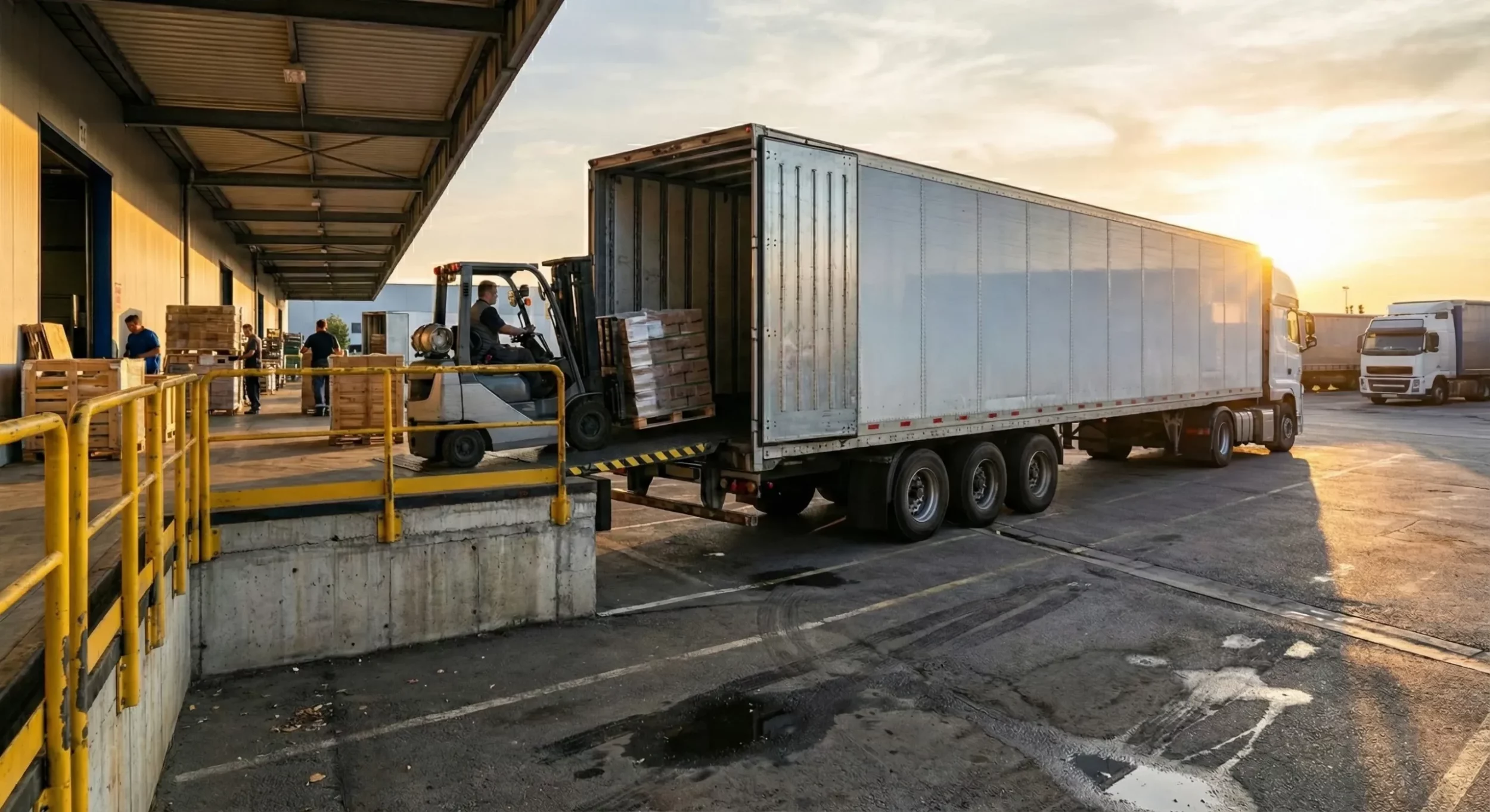
The loading dock height has a direct impact on worker safety, equipment performance, and loading efficiency. The standard loading dock height in North America typically ranges from 48 to 52 inches, with 48 inches being the most common specification. This height is designed to align with standard semi-truck trailer beds; however, facilities handling diverse vehicle types must have solutions to maintain compliance and safe operations.
Dock Height Ranges by Vehicle Type
Different commercial vehicles have varying bed heights that loading facilities must accommodate. The following table provides typical truck bed height ranges for common vehicle types:
| Vehicle Type | Bed Height Range |
|---|---|
| Double Axle Semi | 45″ – 55″ |
| Standard 53′ Trailer | 48″ |
| Container/Intermodal | 52″ – 62″ |
| Flatbeds | 47″ – 62″ |
| Straight/Box Trucks | 40″ – 50″ |
| Reefer Trucks | 50″ – 60″ |
| City Delivery Trucks | 45″ – 48″ |
The 48-inch standard represents an optimal compromise for mixed fleet operations, allowing docks to service both lower and higher truck beds within a workable range .

Recessed and Declined Driveway Considerations
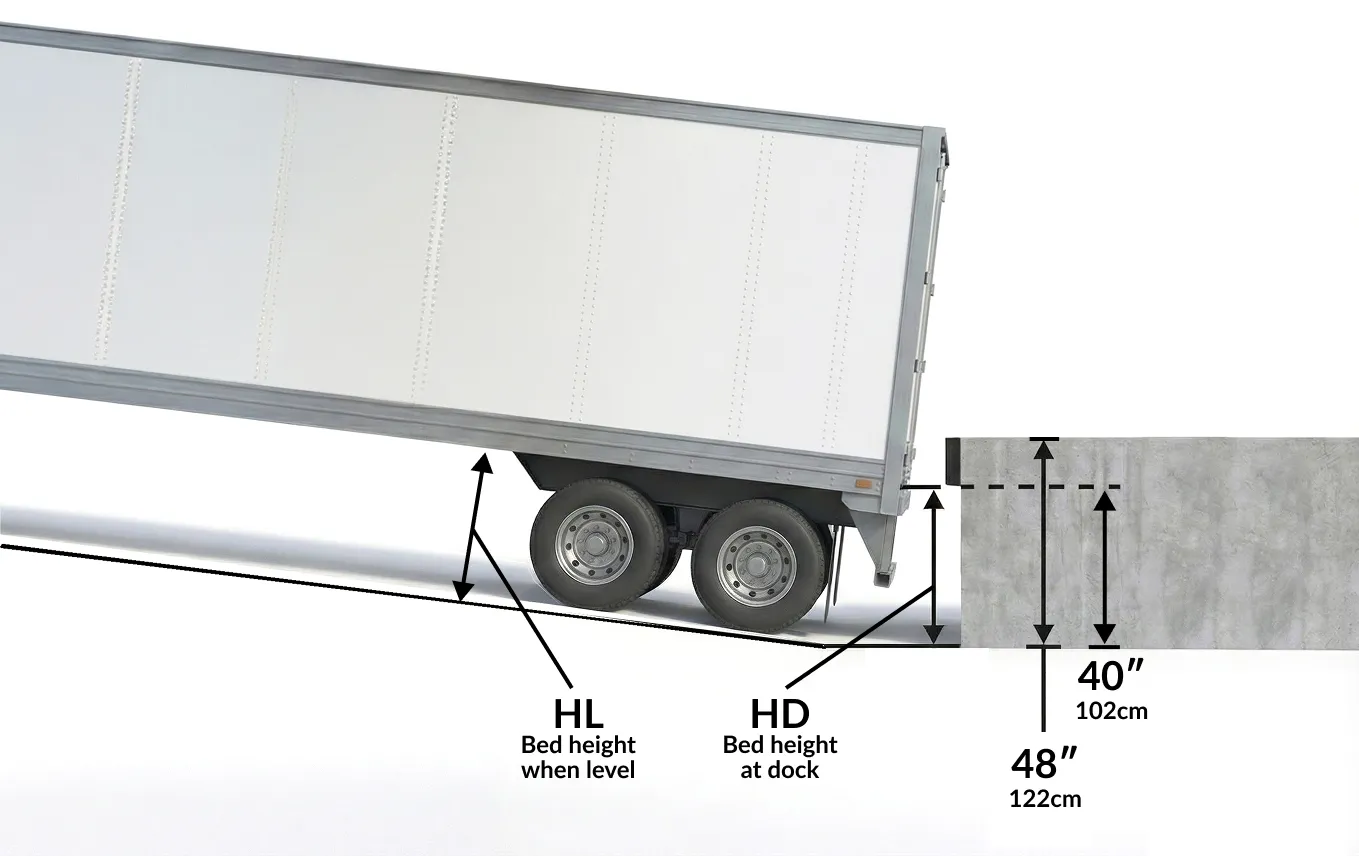
Facilities with recessed or declined dock approaches require special height adjustments. A recessed parking area may lower the effective truck bed height by 6 to 10 inches compared to level approaches. For example, when the drive approach features an 8% decline leading to a level pad at the dock, a typical trailer with a 48-inch bed height (HL or “height when level”) will measure approximately 40 inches (HD or “height at dock”) at the loading position. In this example, facilities should specify a 40-inch dock height to maintain proper alignment. The general guideline is to lower dock height by approximately 1 inch for each 1% of recessed driveway grade.
Declined dock approaches should not exceed a 10% grade for safe operations. Heavy load facilities should limit grades to 5% or less to prevent cargo shifting and trailer creep. Steep slopes create operational hazards, including difficult snow removal, water drainage issues, and potential building strikes from backing trailers. SafeRack’s wheel riser systems accommodate sloped approach conditions through specialized configurations that compensate for uneven positioning.
Solutions for Height Mismatches
Loading docks equipped with dock levelers can effectively service a broader range of vehicle heights than those with fixed dock heights alone. Quality dock levelers typically operate up to 12 inches above and below the installed dock height, meaning a 48-inch dock can accommodate vehicles ranging from 36 to 60 inches high. This operational flexibility compensates for height differences and trailer movement during loading operations.
Dock Levelers
Dock levelers are essential safety equipment that bridge height and gap differences between loading docks and trailers, creating smooth transitions for forklifts and material handling equipment. SafeRack distributes Bluff Manufacturing’s complete line of dock levelers as part of our full solutions service.
Edge-of-Dock Levelers provide permanent solutions mounted to the dock edge, typically handling trucks 5 inches above or below dock height with capacities of 20,000 to 30,000 pounds. These systems feature simple mechanical operation and self-storing handles for space efficiency.
Lo-Dock Levelers offer an innovative solution for facilities with low docks, raising effective dock height from 3 to 20 inches without requiring costly structural modifications. The patented design includes door seals that maintain proper building integrity while providing critical height adjustment.
Wheel and Truck Risers
When docks are positioned lower than needed, wheel risers and truck risers provide safe vehicle positioning. These systems eliminate dangerous below-dock loading conditions while protecting dock equipment from damage.
Wheel Risers are available in aluminum (30,000 lbs capacity) and steel (40,000 lbs capacity) construction, with standard heights from 3 to 12 inches. Proper sizing depends on wheel configuration, with 18-inch widths for single-tire wheels and 24-inch widths for dual-tire applications.
Truck Risers handle heavy-duty positioning with 80,000 pounds capacity per pair, offering height adjustment from 6 to 24 inches. The 42-inch standard width accommodates various truck configurations, while included runoff curbs provide safe vehicle guidance.
SafeRack Terminal Equipment
Beyond height adjustment, SafeRack provides comprehensive terminal equipment that enhances loading dock safety and efficiency:
Truck Chocks and Wheel Blocks prevent vehicle movement during loading operations, a critical safety requirement enforced by OSHA regulations.
Spill Containment Solutions protect facilities and the environment during bulk loading operations, essential for regulatory compliance.
Grounding and Monitoring Systems prevent static discharge incidents during product transfer, protecting personnel, product, and terminal infrastructure.
Loading Dock Stairs
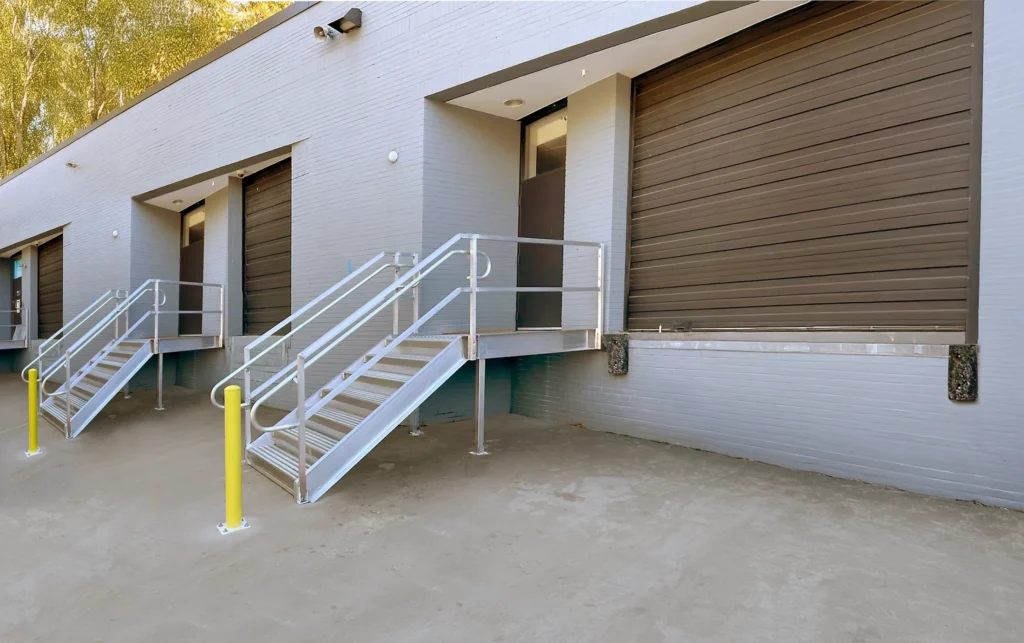
For facilities requiring personnel access loading docks, DockStep provides safe, compliant access. These prefabricated aluminum loading dock stairs feature:
- No welding or special equipment required
- IBC, ADA, and OSHA-compliant options
- 9 inches of vertical adjustability through leveling legs
- Slip-resistant open diamond serrated surfaces
- 100% industrial-grade aluminum construction that won’t rust, warp, or rot
- Fast installation (bolts together in about 1 hour)
Truck Steps
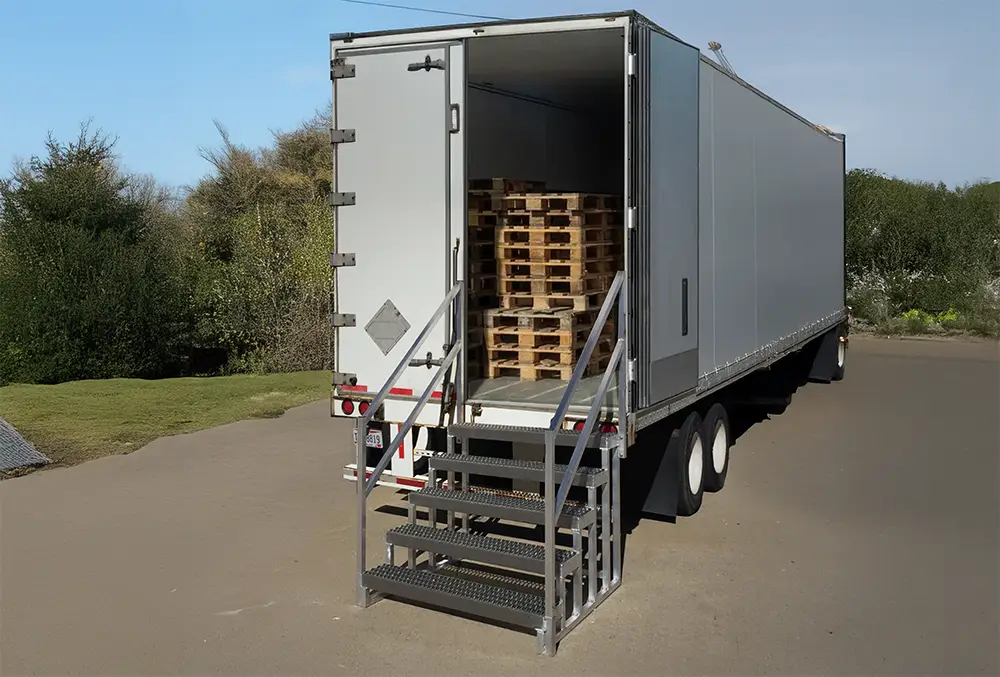
Our truck steps are designed to meet current OSHA safety standards, providing secure access when loading and unloading trucks and semi-trailers. Our steps are constructed from durable and lightweight aluminum and feature slip-resistant treads, providing a secure footing for easy and safe loading and unloading of your trailer.
Flatbed Loading & Tarping Platforms
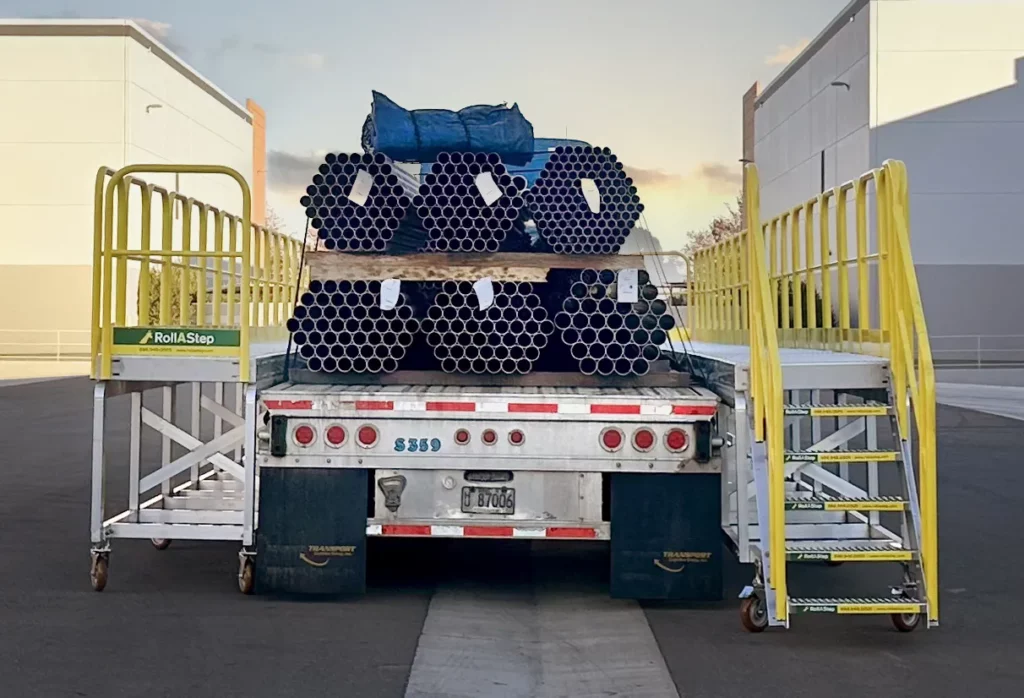
RollaStep Mobile Work Platforms combines the stability of a fixed platform with the mobility of a rolling stair. Its large platform securely supports multiple operators, equipment, and parts.
Mobility option for loading docks – RollaStep’s 360° soft, no-flat swiveling casters roll smoothly over rough surfaces such as asphalt and gravel, enabling precise positioning. Locking casters secure the platform in place, ensuring a stable work environment during use.
OSHA-Compliant Flatbed Truck Loading
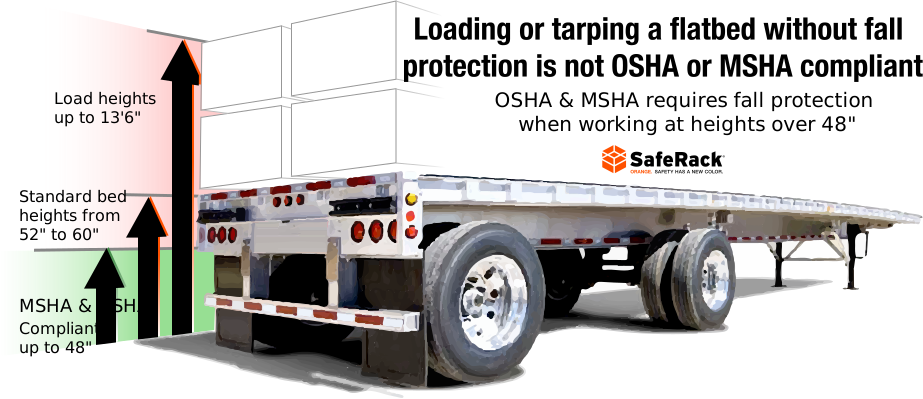
Loading and unloading trucks pose significant risks to flatbed trailer drivers. When loads such as pipes, cement, sheetrock, and lumber need to be wrapped or tarped, operators are frequently responsible for tarping the load. Traditionally, this requires crawling over irregular surfaces and spanning hazardous voids in uneven loads. Falls from atop those loads, which routinely reach 12 or more feet, can be fatal.
OSHA mandates that fall protection be provided for employees working at heights greater than four feet. You may be legally liable for workers on your site even if they aren’t technically employed by you.
Frequently Asked Questions
The most common loading dock height is 48 inches, designed to align with standard 53-foot trailer beds while accommodating the widest range of commercial vehicle types.
Standard dock levelers typically operate up to 12 inches above and below the installed dock height, meaning a 48-inch dock can service vehicles from 36 to 60 inches high.
Facilities customize dock heights based on their specific fleet composition and operational requirements. Operations exclusively servicing straight trucks might use 42-inch docks, while container terminals may specify 54-inch docks for optimal efficiency.
Trailer creep occurs when vehicles move away from the dock during loading, creating dangerous gaps. Prevention requires wheel chocks, trailer restraints, or early departure prevention systems at every loading position.
Yes, OSHA regulations require the use of wheel chocks or trailer restraints at every loading dock bay to prevent vehicle movement during loading operations .
Essential equipment includes dock levelers, wheel chocks or vehicle restraints, proper lighting, fall protection systems, truck positioning equipment, and grounding systems for bulk loading operations.
Inclined or declined approaches impact effective dock height and vehicle positioning. Steep slopes may require additional clearance considerations or cantilevered dock levelers to prevent building strikes during vehicle backing.
Regular inspection and maintenance ensure proper operation, including checking mechanical or hydraulic systems, verifying lip extension mechanisms, inspecting for structural damage, and ensuring all safety features function correctly.
Yes, SafeRack provides comprehensive terminal design services, from on-site safety assessments to full project consultation. Our team ensures your loading dock operations meet compliance requirements while optimizing safety and efficiency.