


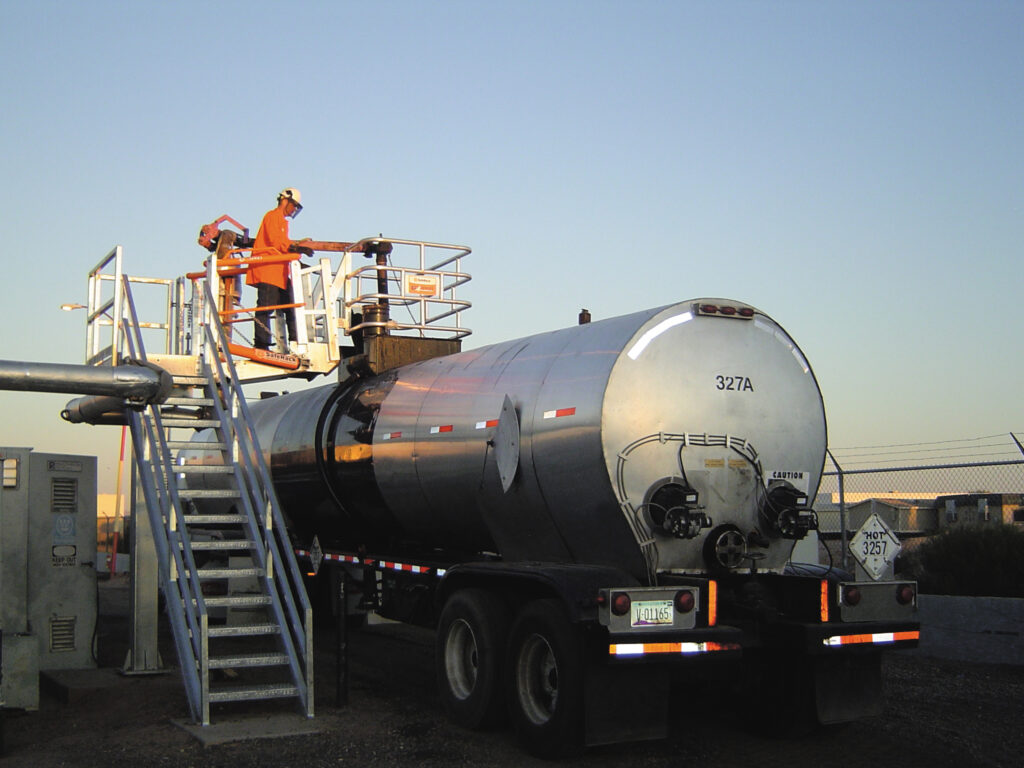
Splash loading, or top splash loading, is a form of top loading that involves filling tanks with material by positioning the fill pipe partially into the destination tank. The name comes from the splash effect that is created when the liquid released through the fill pipe makes contact with the sides of the tank and substances inside. While once common, splash loading is now recognized as a hazardous practice.
How Splash Loading Creates Hazards
Splash loading creates several dangerous conditions. Here is what happens:
- Liquid falls freely through the vapor space in the tank
- The falling liquid splashes against the tank bottom and walls
- Splashing creates fine droplets suspended in the vapor space
- Droplets generate static electricity as they move through the air
- Static charges build up on the liquid and tank surfaces
- A spark can ignite flammable vapors
The splash loading method produces increased agitation and turbulence that can lead to the buildup of static electricity and excess vapors. Proper vehicle grounding and bonding is necessary to prevent disaster. For petroleum refineries, splash loading is prohibited for most volatile products due to explosion risks.
Static Electricity and Explosion Risks
Static electricity is the hidden danger in splash loading. Here is why:
How static builds up
- Liquid moving through air creates charge separation
- Droplets carry electrostatic charge
- Charge accumulates on non-conductive liquids
- The tank can become charged if not grounded
The spark risk
- When charge builds high enough, it discharges
- A spark as small as 0.1 millijoules can ignite vapors
- Gasoline and other fuels have wide flammability ranges
- Explosions have killed workers and destroyed facilities
Environmental Problems with Splash Loading
Splash loading harms the environment in several ways. Here is what happens:
- Liquid droplets escape through tank vents
- Vapors are pushe out as the tank fills
- Product lost to the atmosphere
- Volatile organic compounds (VOCs) contribute to smog
- Neighbors may complain about odors
Inefficiency of Splash Loading
Splash loading is also operationally inefficient. Here is why:
- Only one compartment can be fill at a time
- Splashing slows down filling rates
- Foaming may require slower fill speeds
- Vapor generation may require pause to vent
- Product loss means less delivered product
Submerged Loading as a Safer Alternative
Submerged loading eliminates the hazards of splash loading. Here is how it works:
Submerged loading is a method of filling a tank in which the fill pipe is nearly or completely submerged below the surface of the liquid that is being load into the tank. There are two methods of submerged loading: traditional top loading and bottom loading.
Submerged top loading
- Fill pipe inserted through top opening
- Pipe lowered until just above tank bottom
- Liquid enters below the surface
- Less agitation and turbulence
Bottom loading
- Material pumped through fittings underneath the truck
- Fill pipe is below the liquid surface
- Turbulence is controll
- Vapors and static buildup reduced
Submerged Top Loading Explained
Submerged top loading is a direct alternative to splash loading. Here is how it works:
- A fill pipe is inserte through an opening in the top of the tank
- The fill pipe is lower until just above the bottom of the tank
- Liquid flows out below the existing liquid surface
- No splashing or falling liquid through vapor space
- Much less static generation
Submerged top loading involves inserting a fill pipe through an opening in the top of the tank. The fill pipe is lower until it is located just above the bottom of the tank. This method produces less agitation and turbulence than splash loading, reducing static buildup and harmful vapor emissions. For top loading arms, submerged loading requires a longer drop tube to reach near the tank bottom.
Bottom Loading Explained
It is another method that avoids splash loading. Here is how it works:
- Connections made at ground level
- Product enters through the bottom of the tank
- Fill pipe is always below liquid surface
- No vapor space exposure during filling
- Lowest static generation of all methods
The involves pumping material into cargo tanks through a system of fittings and valves that are mounted underneath the truck. Since the fill pipe is located below the surface of the liquid, turbulence is controlled, which reduces vapors and static buildup. For bottom loading arms, this method is preferred for gasoline and other high-volatility products.
Grounding and Bonding for Static Control
Proper grounding is essential when any form of splash loading occurs. Here is what is need:
- Tank truck must be grounded to earth
- Bonding wire connects fill pipe to tank
- Static charge dissipates safely
- No spark can occur
- Static grounding systems verify connection
Overfill protection also prevents spills during loading operations. Breakaway couplings prevent spills if a truck drives away during splash loading.
It is a top loading method where the fill pipe is positioned partially into the tank, causing liquid to splash against tank sides.
It creates static electricity buildup and excess vapors, which can cause catastrophic explosions when combined.
Submerged loading is a filling method where the fill pipe is below the liquid surface, reducing turbulence, static, and vapors.