


Passivation is a chemical treatment and preparation applied to stainless steel surfaces and welds to remove free iron and contaminants, rebuild a thin oxide layer that improves corrosion resistance, cleanability, and equipment life, and prevent corrosion. In industrial and manufacturing settings, passivating is often the difference between stable, low‑maintenance systems and corrosion‑driven downtime.
- Passivation (industrial/manufacturing): A controlled post‑fabrication chemical process, typically using nitric or citric acid that cleans stainless steel and welded areas of free iron and shop contamination, allowing a chromium‑rich passive film to form that resists rust, pitting, and product contamination.
- Proper passivation can reduce corrosion rates by orders of magnitude compared to untreated stainless, depending on the environment and chemistry.
- In regulated sectors (e.g., FDA, cGMP, aerospace), passivation is often required by standards such as ASTM A967 and tied directly to validation, documentation, and quality audits.
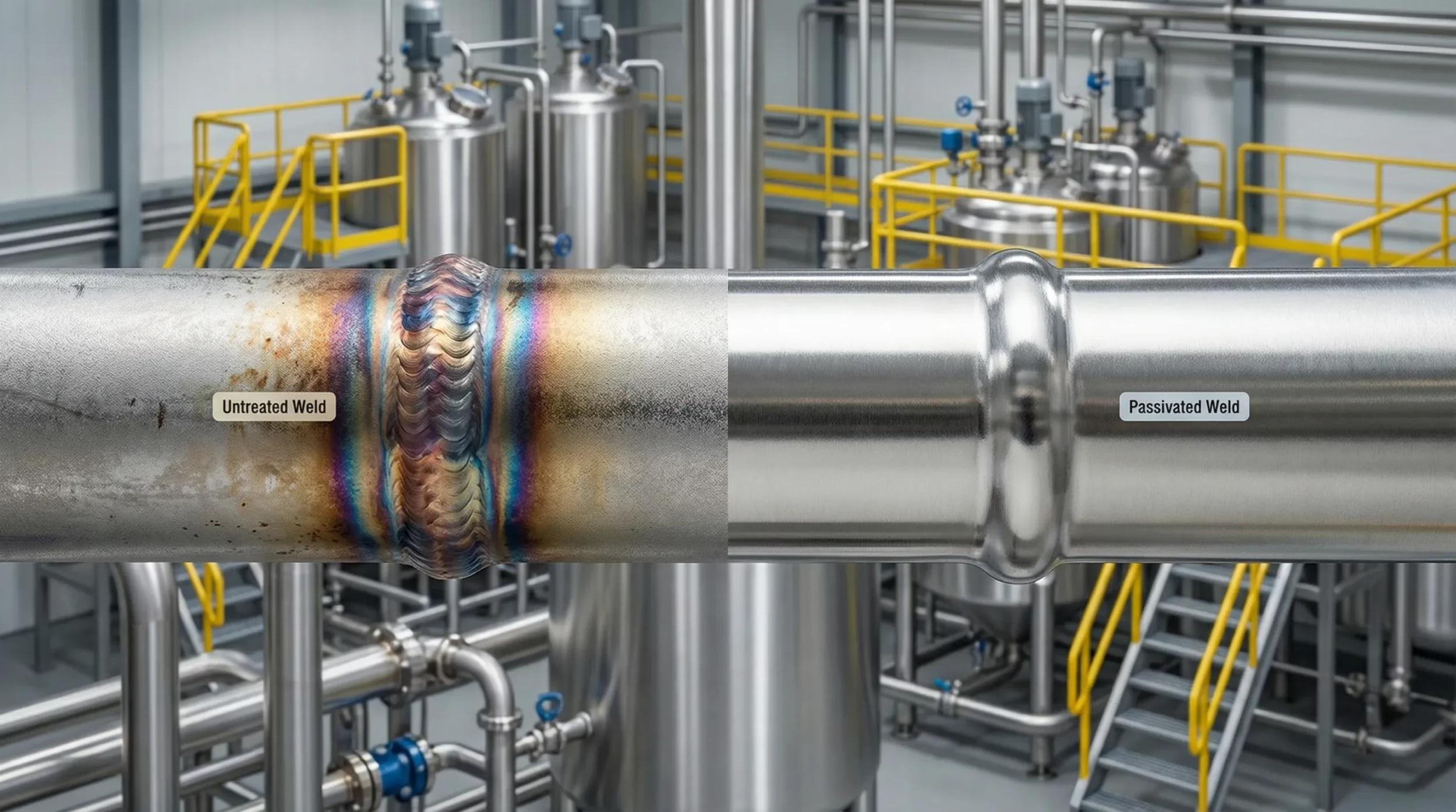
Why passivation matters
- Safety and contamination control: Reduces rust particles, rouging, and metal ions entering product or process streams—critical where product purity or worker exposure are concerns.
- Cost and downtime: Doing passivation correctly up front is far cheaper than unplanned failures; corrosion‑related failures can cost many times more once you include emergency repairs, production loss, and cleanup.
- Cleanability and sanitation: A properly passivated surface is smoother and less reactive, making it easier to clean and less likely to trap residues or harbor bacteria, which supports CIP/SIP performance and sanitation inspections.
Industries that rely on passivated welds
Multiple sectors depend on passivated welds wherever stainless is exposed to product, cleaning chemicals, or harsh atmospheres:
- Food & beverage processing
- Tanks, bottling lines, mix kettles, conveyors over open product, and CIP circuits use passivated welds to prevent rust, micro‑pitting, and contamination that would threaten food safety and regulatory compliance.
- Especially important in high‑temperature, frequent‑washdown zones with caustics and acids.
- Dairy and brewing
- Pasteurization lines, fermenters, bright beer tanks, and dairy tanks operate with hot caustic and acidic cleaners; passivated welds help prevent rouging and maintain a smooth, cleanable surface profile.
- Pharmaceutical and biotech
- Process piping, reactors, WFI systems, and skids are routinely passivated, often with documented and standardized procedures, to support cGMP and FDA expectations for corrosion control and cleanability.
- Loss of passivation here can force shutdowns and re‑validation, making weld passivation a key reliability and quality step.
- Medical devices and life‑science equipment
- Surgical instruments, implants, and stainless housings use passivation after machining and welding to maintain biocompatibility and corrosion resistance through repeated sterilization cycles.
- Chemical manufacturing and bulk chemical handling
- Welded stainless tanks, piping, and components in contact with acids, caustics, oxidizers, and chlorides rely on passivated welds to reduce pitting, leaks, and spill risk.
- Passivation helps extend inspection intervals and minimizes corrosion‑driven repairs.
- Semiconductor and electronics
- Ultra‑clean stainless gas lines, chemical delivery systems, and process chambers rely on passivated surfaces to limit particle generation and metallic contamination that can kill yield.
- Aerospace and defense
- Stainless fasteners, springs, fittings, and components are passivated for high‑reliability, high‑corrosion‑risk environments (temperature swings, humidity, de‑icing chemicals).
- Many aerospace specifications explicitly call out passivation steps.
- Marine, coastal, and harsh outdoor environments
- In salt‑spray and coastal conditions, passivated stainless welds better resist chloride‑driven pitting and crevice corrosion, extending service life for ladders, platforms, handrails, and pipework.
- Data centers and cooling systems
- Stainless cooling loops, manifolds, and wetted components are increasingly passivated to reduce rouging, maintain thermal performance, and prevent corrosion‑related leaks that could threaten uptime.
Typical applications needing passivated welds
Common situations where passivating welds is required or strongly recommended:
- Product‑contact stainless surfaces
Process tanks, hoppers, chutes, mixers, and piping where product or cleaning chemicals directly contact welded stainless. - High‑purity fluids and gases
WFI, ultra‑pure water, high‑purity chemicals, and gas systems where even trace corrosion products or rouging can impact quality, performance, or validation. - Aggressive CIP/SIP and washdown zones
Areas cleaned with hot caustic, acids, or oxidizers; passivated welds hold up better to repeated cycles and maintain surface integrity. - Critical fasteners and springs
Springs, wire forms, and fasteners used in medical, aerospace, marine, and hygienic equipment are often passivated for both corrosion resistance and cleanliness.
How this relates to ErectaStep and SafeRack
- Standard ErectaStep platforms, stairs, and work platforms are built from industrial‑grade aluminum and are designed for general industrial access and crossover applications, which typically do not require passivated welds.
- By default, ErectaStep does not include passivated welds, because most uses (tank farm access, mezzanine access, crossovers, and maintenance platforms) are non‑product‑contact and are adequately protected by the inherent corrosion resistance of aluminum and other finishes.
- For direct food contact, food‑zone washdown, pharmaceutical, or other hygienic or high‑purity environments where stainless construction and passivated welds are required, SafeRack can manufacture access and platform solutions with passivated welds to align with your sanitation, audit, and validation requirements.
If you outline your application (food zone vs. non‑product‑contact, washdown chemistry, and inspection requirements), a short, application‑specific recommendation can be made on when passivated welds are necessary and when standard ErectaStep is the most efficient option.
Passivation removes contaminants from stainless steel and welds, creating a protective layer that resists corrosion and extends equipment life.
Food & beverage, pharmaceutical, biotech, medical devices, chemical manufacturing, semiconductor, aerospace, marine, and data centers.
Standard ErectaStep platforms do not require passivation because aluminum naturally resists corrosion. Passivated welds are only needed for product-contact or hygienic applications.
Nitric acid or citric acid are commonly used to remove free iron and rebuild the passive layer on stainless steel.
Proper passivation prevents rust, pitting, and contamination, reducing emergency repairs, production downtime, and replacement costs.