


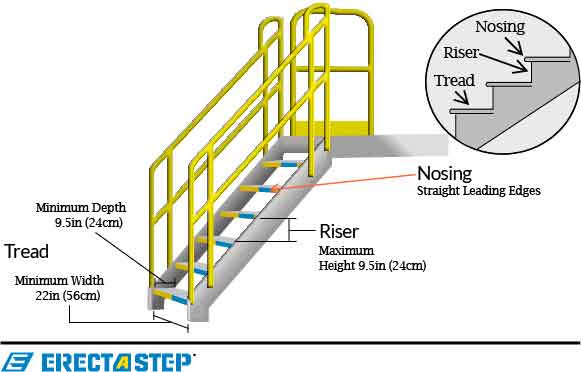
Nosing refers to the front edge or overhang of a stair tread. It plays an important role in stair safety by providing additional surface area and improving visibility for each step. In industrial and commercial environments, nosing is often designed with non-slip materials to reduce the risk of slips and falls.
According to OSHA Standard 1910.25(f)(5), if stairs do not have a projecting nosing, they must include at least 7 inches of leading edge on each step. Proper nosing design is essential for maintaining safe and compliant stair systems.
How Nosing Works
It is improves stair safety by enhancing step visibility and traction.
Function:
- Extends slightly beyond the stair tread edge
- Increases usable step surface area
- Improves foot placement during movement
- Often includes anti-slip materials for added grip
- Enhances visibility, especially in low-light environments
In industrial settings, It is commonly integrated into access systems such as stairways and platforms to improve overall safety.
Applications
It is widely used in:
- Industrial stair systems
- Commercial buildings
- Loading platforms and access structures
- Warehouses and manufacturing facilities
- Elevated work areas
These environments often use safe access systems like loading platforms and gangways for safe movement between areas.
Benefits and Importance in Nosing
Proper nosing provides several safety and operational benefits:
- Improves traction and reduces slip risk
- Enhances stair visibility and safety
- Supports OSHA compliance requirements
- Increases durability of stair edges
- Reduces wear and tear on stair treads
In high-risk environments, nosing works alongside safety systems such as guardrails and fall protection systems.
Safety Considerations
It is a critical safety feature in stair design, especially in industrial environments.
Key considerations include:
- Use of non-slip materials for better traction
- Proper step dimensions to meet OSHA standards
- Regular inspection for wear or damage
- Clear visibility markings on stair edges
Safe stair access systems are often combined with safety cages and ladders.
It is the front edge or overhang of a stair tread that improves safety and visibility.
It helps reduce slips and falls by improving traction and making each step more visible.
OSHA requires that stairs have proper nosing or at least 7 inches of leading edge if it is not present.
It is use in industrial, commercial, and workplace stair systems where safety is a priority.