

MRO stands for maintenance, repair, and operations, and it covers the people, processes, parts, and services that keep your facility, equipment, and access systems safe, compliant, and running, without directly becoming part of the final product.
What MRO Is
In industrial environments, MRO is the catch‑all term for the work and materials needed to support day‑to‑day operations and long‑term asset reliability.
- It includes routine maintenance, corrective repairs, inspections, cleaning, adjustments, and overhaul work.
- It also covers the indirect inventory that supports this work: tools, PPE, spare parts, safety systems, and access equipment.
For operations, safety, maintenance, and engineering teams, MRO is where uptime, compliance, and cost control come together.
Core MRO Categories
Most plants group MRO into a few practical categories:
- Production equipment – Work and parts that keep process equipment (pumps, mixers, conveyors, packaging lines, etc.) in spec and available.
- Facility and utilities – Building structure, roofs, lighting, HVAC, electrical, plumbing, fire systems, and grounds.
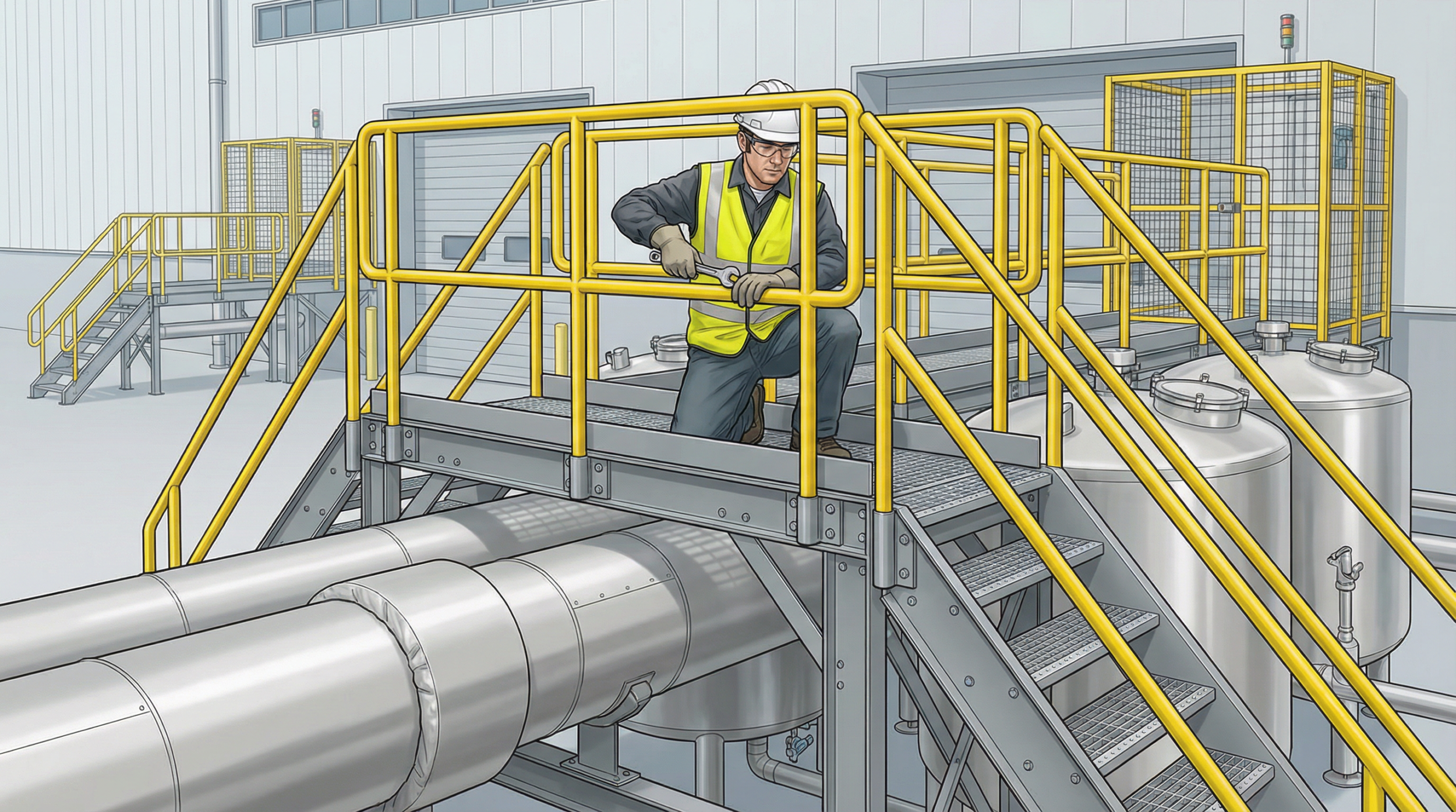
- Safety and access – Platforms, gangways, stairs, cages, guardrails, safety gates, fall protection, and loading systems that allow safe access for operation and maintenance.
- Material handling – Forklifts, rolling stairs, mobile platforms, hoists, and other equipment that move people and materials safely.
- Indirect/inventory – Lubricants, fasteners, gaskets, filters, bearings, tools, PPE, hoses, fittings, sealants, and similar items that support maintenance and operations.
SafeRack, ErectaStep, YellowGate, and RollaStep solutions sit primarily in the safety and access MRO category, but they directly impact uptime and maintenance efficiency across all categories.
Why MRO Matters
Good MRO programs drive safety, uptime, and cost control. Poor MRO shows up as injuries, unplanned downtime, and emergency purchases.
Key benefits:
- Safety and compliance
- Regular inspections and preventive maintenance keep platforms, gangways, stairs, and loading racks in safe working condition.
- Properly designed access (for example, ErectaStep platforms and stairs) reduces fall risk and helps maintain OSHA compliance during maintenance work.
- Reduced downtime
- Planned maintenance and critical spares reduce the frequency and length of unplanned outages.
- Standardized access systems make it faster and safer for technicians to reach equipment, which shortens repair and inspection time.
- Operational efficiency and cost control
- Organized MRO inventory and standardized components (like modular stairs and platforms) reduce one-off fabrication and site-built workarounds.
- Better MRO planning lowers overtime, rush shipping, and emergency rental costs, while extending asset life.
ErectaStep and MRO
ErectaStep is a key MRO tool because it gives maintenance and operations teams fast, standardized, and modular access where they need it.
How ErectaStep supports MRO:
- Modular access for maintenance
- Prefabricated stairs, platforms, and crossovers provide safe access to valves, pumps, filters, tank manways, roof penetrations, and overhead equipment.
- Modular components bolt together with no welding, which means maintenance teams can reconfigure platforms as equipment or process layouts change.
- Standardization and repeatability
- Using a standard ErectaStep “kit of parts” simplifies design, installation, and future changes compared to custom-fabricated structures.
- Standard components reduce spare-parts complexity and speed replacement if a section is damaged or needs to be reconfigured.
- Downtime reduction
- Quick-ship, bolt-together systems can be installed during short outages, minimizing production impact.
- Better access to equipment improves inspection frequency and quality, supporting preventive and predictive maintenance programs.
Positioning for your glossary: call out ErectaStep as a go‑to MRO solution when teams need safe, fast, and reconfigurable access to equipment for inspection, service, and repair.
Notable MRO Facts and Talking Points
You can use these “stat” style points in your post to make MRO feel real and high-impact:
- MRO spend is a significant slice of indirect procurement, often representing a noticeable portion of a plant’s annual supply chain budget.
- Poorly managed MRO leads to both overstock (cash tied up on the shelf) and critical stockouts (emergency buys, premium freight, and downtime).
- Standardizing on modular access systems like ErectaStep and mobile platforms like RollaStep helps reduce custom fabrication, inspection time, and future modification costs.
- Integrating MRO planning with safety (fall protection, access, and safe egress) reduces both incident rates and time-on-task for maintenance crews.
- Partnering with suppliers that offer inspections and preventive maintenance services (such as SafeRack’s equipment inspection programs for loading racks and gangways) strengthens your overall MRO strategy.
SafeRack, ErectaStep, and MRO Services
SafeRack plays directly into MRO by combining engineered equipment with services:
- On-site safety walks and loading-rack evaluations to identify access and fall-protection issues before they turn into incidents or downtime.
- Inspection and preventive maintenance for platforms, gangways, MAXRack systems, and other access and loading equipment.
- Modular, prefabricated access solutions through ErectaStep and mobile access via RollaStep to support maintenance work with minimal disruption.
Your Regional Area Manager (RAM) effectively acts as an MRO partner, helping you design access, specify equipment, and plan inspections so maintenance can be done safely, quickly, and consistently.