


Understanding the difference between grounding vs. bonding is critical for controlling static electricity in hazardous industrial environments. While both are essential safety practices, they serve different purposes and must be used together to prevent dangerous incidents.
In bulk handling operations, systems like grounding and monitoring solutions and safe access equipment such as loading platforms play a key role in maintaining operational safety. Knowing how grounding vs. bonding works helps reduce risks during loading, transfer, and storage of flammable materials.
What Is Grounding?
Grounding (also called earthing) connects equipment directly to the earth through a conductive path. This allows static charges to safely dissipate into the ground, eliminating voltage buildup.
Key Functions of Grounding:
- Provides a direct path to earth through grounding systems
- Completely eliminates static charge accumulation
- Requires resistance below 10 ohms (NFPA 77 / API standards)
- Must be regularly tested and maintained
- Essential for trucks, railcars, and fuel-handling equipment
Grounding is commonly used with truck and railcar loading systems to ensure safe fuel transfer operations.
What Is Bonding?
Bonding connects two or more conductive objects to equalize their electrical potential. Instead of removing static charge, bonding prevents sparks between objects.
Key Functions of Bonding:
- Connects equipment using wires or bonding cables
- Equalizes electrical potential between surfaces
- Prevents sparks during product transfer
- Required even when surfaces are touching
- Works best when combined with grounding systems
Bonding is especially important in systems using loading arms and couplings where fluid transfer creates static buildup.

Grounding vs. Bonding: Key Differences
- Purpose:
- Grounding eliminates static charge
- Bonding equalizes charge between objects
- Connection Type:
- Grounding connects equipment to earth
- Bonding connects equipment to equipment
- Charge Elimination:
- Grounding removes static completely
- Bonding only balances electrical potential
- Safety Role:
- Grounding prevents buildup
- Bonding prevents sparks
Both methods are required together for complete protection in industrial environments.
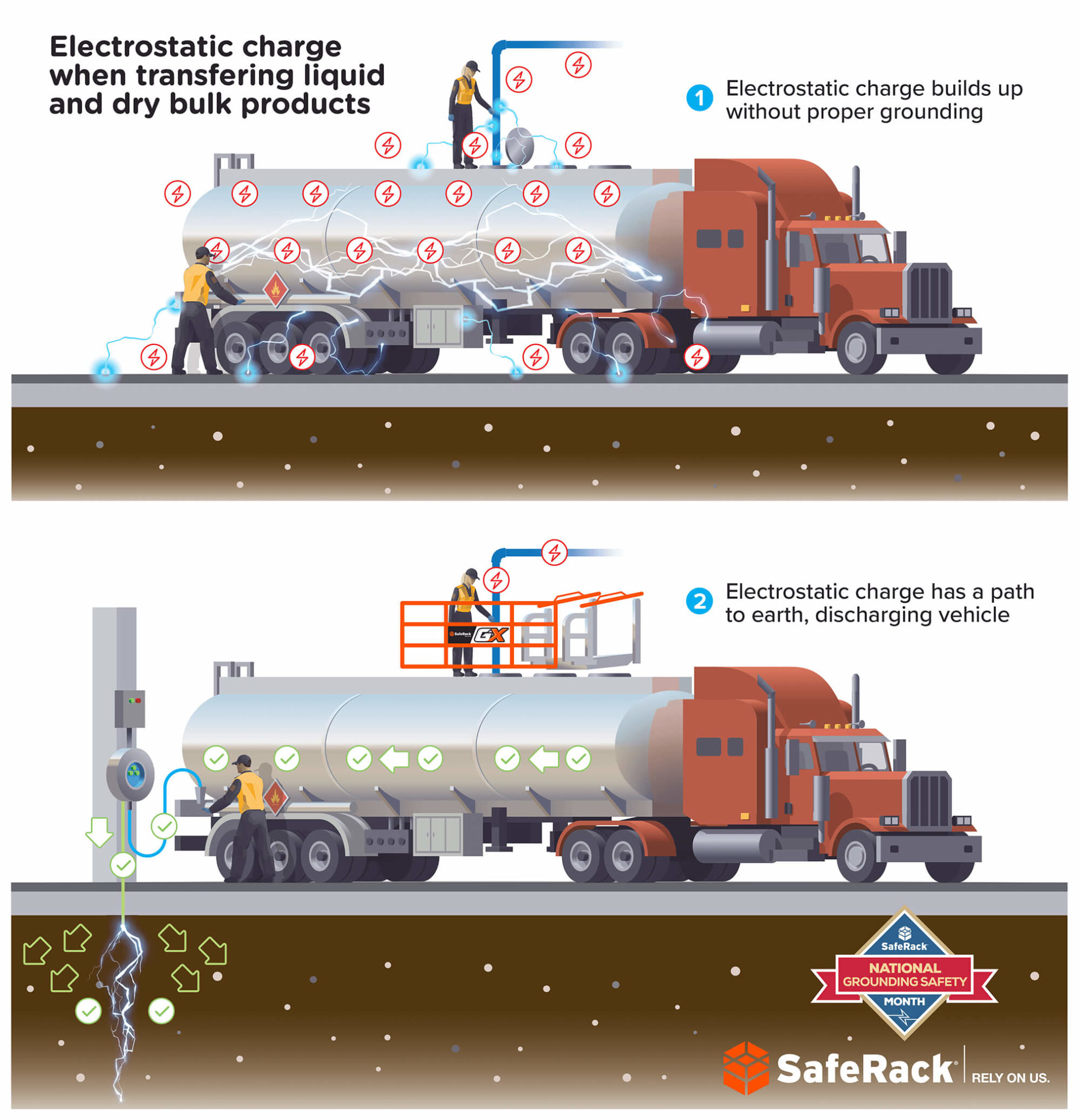
Applications
Grounding vs. bonding is critical in:
- Truck and railcar loading operations
- Fuel and chemical transfer systems
- ISO container filling operations
- Bulk storage and distribution facilities
- Manufacturing and processing plants
These environments rely on systems such as railcar gangways and fall protection equipment to ensure safe worker access during operations.
Benefits and Importance
Using both grounding vs. bonding together provides:
- Complete static electricity control
- Reduced risk of sparks and explosions
- Improved compliance with safety standards
- Safer transfer of flammable materials
- Enhanced worker protection
Industrial safety is further supported by equipment like safety gates that help control access during hazardous operations.
Real-World Scenarios
Without Proper Bonding:
- Different voltage levels between objects
- Sparks during transfer operations
- Increased fire or explosion risk
Without Proper Grounding:
- Static charge builds up on equipment
- Bonded systems still carry dangerous energy
- Risk of discharge to nearby objects or personnel
Grounding removes static electricity by connecting to earth, while bonding equalizes electrical potential between objects.
Both are required because grounding eliminates charge, while bonding prevents sparks between equipment.
They are used in fuel handling, chemical transfer, and industrial loading operations.
Without them, static buildup and sparks can lead to fires, explosions, and serious safety risks.