


Fall Clearance or freefall distance is the total vertical distance required to safely stop a worker during a fall before they come into contact with the ground or any obstruction. It is a critical part of fall protection planning, ensuring that safety systems provide enough space to prevent serious injury. Proper fall clearance depends on factors such as anchor point location, lanyard length, and deceleration distance, all of which must be considered to ensure a safe and effective fall protection system.
How Fall Clearance Works
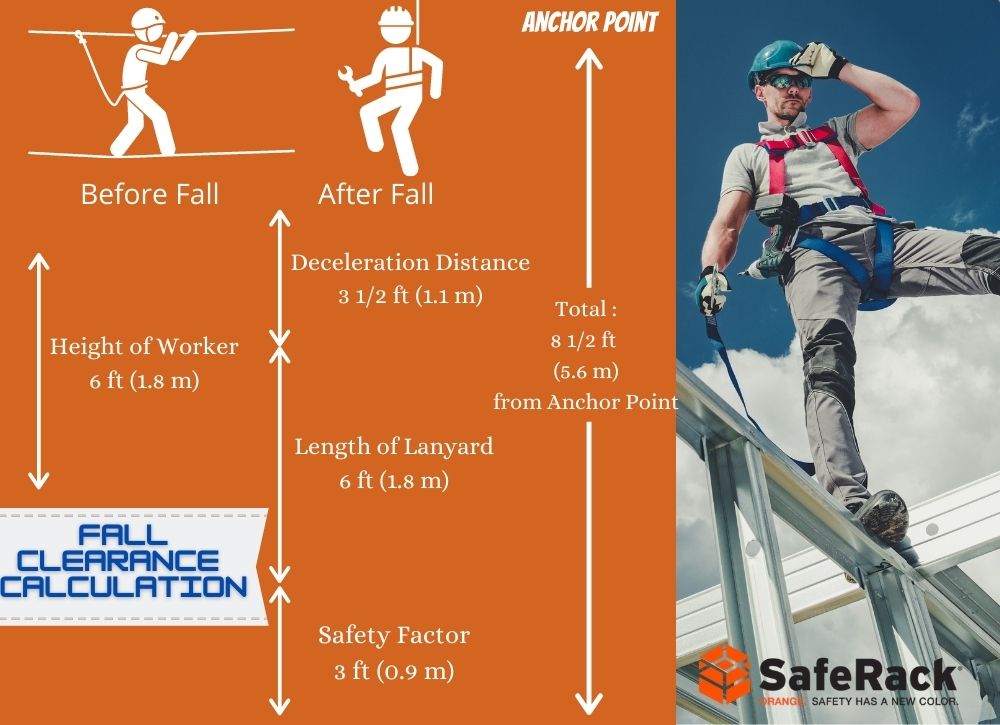
Fall Clearance is calculated by combining multiple factors that affect how far a worker travels during a fall.
- Lanyard length
- Deceleration distance (shock absorber extension)
- Height of the worker
- Safety margin
Formula: Required Distance = Lanyard Length + Deceleration Distance + Worker Height + Safety Factor
Proper calculation of Fall Clearance ensures that the fall arrest system can stop a worker safely.
Fall Clearance and OSHA Safety Requirements
- According to OSHA guidelines, fall protection systems must control free fall distance and arresting forces.
- Free fall distance is typically limited to 6 feet (1.8 meters) depending on the lanyard length and anchor point location.
- Maximum arresting force limits:
- 900 pounds (4 kN) when using a body belt
- 1,800 pounds (8 kN) when using a full body harness
- These limits help reduce the risk of injury during a fall.
- Proper selection of safety components such as anchors, connectors, and lanyards is essential for safe operation.
- System design and inspection must be carried out by a competent person trained to identify hazards and ensure compliance with safety standards.
Key Factors Affecting Fall Clearance
- Anchor point location and height
- Type and length of lanyard used
- Freefall distance
- Presence of nearby obstacles or structures
- Work environment conditions
Each of these factors must be carefully evaluated to maintain safe Fall Clearance.
Applications of Fall Clearance
- Construction sites
- Industrial facilities
- Rooftop maintenance areas
- Loading and unloading platforms
In these settings, proper Clearance helps reduce the risk of impact injuries.
Safety and Compliance
Maintaining correct Clearance is necessary for meeting safety standards such as OSHA guidelines.
- Limiting freefall distance to recommended levels
- Using appropriate fall arrest equipment
- Ensuring sufficient clearance below the worker
- Following proper inspection and maintenance procedures
Correct use of Fall improves overall workplace safety and compliance.
Benefits
Ensuring adequate provides several advantages:
- Supports compliance with safety regulations
- Reduces risk of injury during falls
- Improves the effectiveness of fall protection systems
- Enhances worker confidence and safety awareness
Fall Clearance is the total vertical distance needed to safely stop a worker during a fall.
It prevents workers from hitting the ground or obstacles during a fall.
It is calculate use lanyard length, deceleration distance, worker height, and a safety factor.
It is use in construction, industrial work, and any environment where working at height is required