


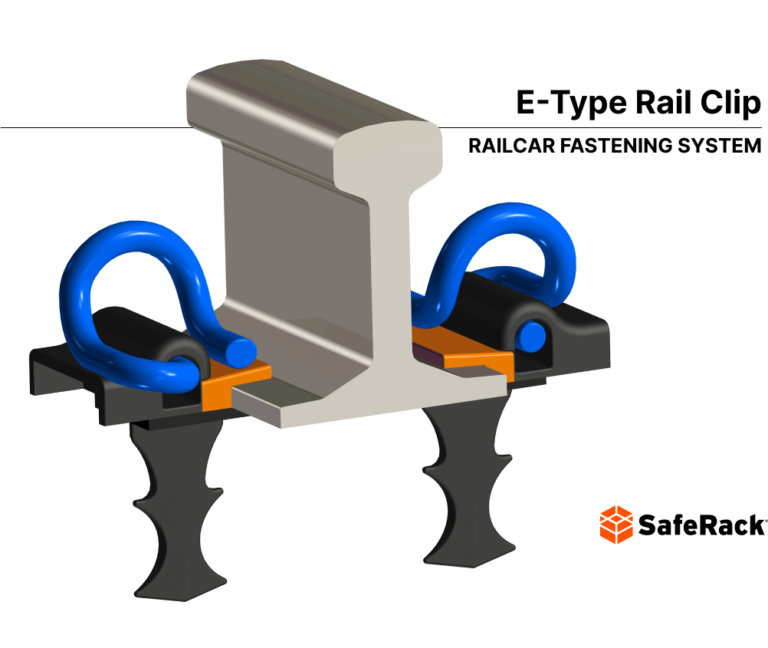
It is also known as an elastic rail fastening or E-clip, is a spring-loaded fastening device that provides permanent elastic clamping for rail systems. These clips mount to sleepers using four coach screws and double spring washers, creating a secure yet flexible connection. Itdesign provides a firm grip on the rail while allowing controlled movement and vibration absorption. Why does this matter? Trains create constant vibration and thermal expansion causes rails to grow and shrink. A rigid fastener would crack or loosen over time. They solves this problem by holding the rail firmly while still allowing it to move slightly. This flexibility is crucial for maintaining track geometry under varying loads and temperatures. If your facility handles railcars, you probably use railcar loading systems that rely on well-maintained tracks secured with E-type rail clips.
How an E-Type Rail Clip Works
They gets its name from its shape, which looks like the letter E. Here is how it works:
- The clip is made from spring steel
- It fits into a cast iron or steel housing on the sleeper
- Four coach screws mount the housing to the sleeper
- Double spring washers add extra holding power
- The clip presses down on the rail foot
- The spring action allows rail movement under load
When a train passes over, the rail tries to push down and sideways. They resists these forces but does not fight them completely. Instead, it flexes slightly and then returns to its original position. This elastic property helps reduce stress on rails, extending their operational lifespan. For petroleum refineries that receive crude oil by rail, properly fastened tracks with E-type rail clips are essential for safe tank car positioning.
Parts of an E-Type Rail Clip Assembly
A complete assembly includes several components working together. Here are the main parts:
- E-clip – The spring steel fastener shaped like the letter E
- Clip housing – Cast iron or steel base that holds the clip
- Coach screws – Four large screws that anchor the housing to the sleeper
- Double spring washers – Provide additional vibration resistance
- Rail pad – Rubber or plastic cushion between rail and sleeper
- Insulator – Prevents electrical current from passing through the clip
The itself is just one part of a complete fastening system. All these components work together to keep the rail in place. Many bulk chemical plants have rail sidings that use to secure tracks for tank car loading.
History of Rail Fastening Systems
Rail fastening technology has come a long way. Here is a brief history:
- 3838 BC – The Post Track in England, one of the earliest known railways
- 1600s – Wooden rails with wooden pegs
- 1700s – Iron straps on wooden rails
- 1800s – Cast iron rails with spikes
- 1900s – Steel rails with chair screws and bolts
- 1950s – Spring clips like the E-type rail clip introduced
- Today – Advanced elastic fastening systems worldwide
Modern systems employ various components including clips, spikes, bolts, and tie plates to maintain track stability and safety. These systems must balance rigid support with flexibility to accommodate thermal expansion and dynamic loading. The represents a major advancement in this evolution. For oil and gas facilities with rail access, modern E-type rail clips provide reliable track fastening for heavy tank cars.
Benefits of E-Type Rail Clips
They offers several important benefits for railway tracks. Here are the key advantages:
- Provides elastic clamping that absorbs vibration
- Allows controlled rail movement under thermal expansion
- Reduces stress on rails, extending their lifespan
- Requires less maintenance than rigid fasteners
- Holds gauge more consistently over time
- Works with wood, concrete, or steel sleepers
- Can be installed and removed with simple tools
Where E-Type Rail Clips Are Use
It are found on many types of railway tracks. Here are the most common applications:
- Mainline railroad tracks
- Industrial sidings
- Rail yard switching tracks
- Curved track sections
- Bridges and tunnels
- High-speed rail lines
- Heavy haul routes
- Port and terminal tracks
E-Clip vs Other Rail Fasteners
It is one of several rail fastening options. Here is how it compares:
E-type rail clip
- Spring steel, elastic clamping
- Allows controlled rail movement
- Excellent vibration resistance
- Moderate installation cost
- Long service life
Rail spike
- Driven directly into wood sleeper
- No elastic properties
- Can work loose over time
- Low cost but high maintenance
Coach screw
- Screwed into wood or plastic sleeper
- Some vibration resistance
- Higher holding power than spikes
- Moderate cost
Pandrol clip
- Similar elastic design to E-clip
- Different shape and mounting method
- Also provides spring action
- Common on concrete sleepers
It is preferred in many applications because it balances cost, performance, and ease of maintenance. For dry bulk loading of frac sand, stable tracks keep railcars in position during filling.
Installation and Maintenance
Proper installation of it is important for performance. Here are key steps:
- Drill holes in the sleeper if not pre-cast
- Insert coach screws with double spring washers
- Torque screws to the specified value
- Seat the E-type rail clip into the housing
- Check that the clip presses firmly on the rail foot
During maintenance, workers check for:
- Loose coach screws
- Damaged or cracked clips
- Worn spring washers
- Corrosion on any components
- Proper clip tension
A well-maintained will last for decades. The clip itself rarely fails. The coach screws and washers are the parts that may need replacement over time. For safe track access during maintenance, railcar gangways help workers reach inspection.
Safety and Rail Fastening
Properly installed contribute to rail safety in several ways. Here is why they matter:
- Maintain proper track gauge
- Prevent rail rollover under heavy loads
- Reduce derailment risk
- Extend rail life
- Lower maintenance frequency
Railroad safety encompasses both infrastructure integrity and worker protection. When tracks are properly fastened with E-type rail clips, trains stay on the rails where they belong. For worker protection during rail maintenance, fall protection systems keep employees safe while inspecting. Safety gates provide secure access to track areas where maintenance occurs.
E-Type Rail Clips in Extreme Conditions
They perform well in challenging environments. Here is how they handle different conditions:
Heat
- Tracks can reach 140°F in direct sun
- The E-type rail clip allows rail expansion without buckling
- Spring action maintains clamping force even when rail grows
Cold
- Tracks can drop below -40°F in some regions
- The clip allows rail contraction without breaking
- Steel remains flexible at low temperatures
Heavy loads
- Unit trains can weigh over 20,000 tons
- The E-type rail clip absorbs impact forces
- Elastic properties reduce stress on rail and sleepers
Wet and corrosive environments
- Clips are often coated or galvanized
- Regular inspection catches corrosion early
- Replacement clips are readily available
For pneumatic trailer loading, stable tracks with E-type rail clips keep trailers in position during high-pressure transfer.
It is a spring-loaded elastic fastening device that provides permanent clamping for rail systems while allowing controlled movement.
Its provide elastic clamping that absorbs vibration and allows thermal expansion, while spikes are rigid and can work loose over time.
Four coach screws and double spring washers mount the clip housing to the sleeper, creating a secure yet flexible connection.
They are used on mainline tracks, industrial sidings, rail yards, curves, bridges, tunnels, and high-speed rail lines.