


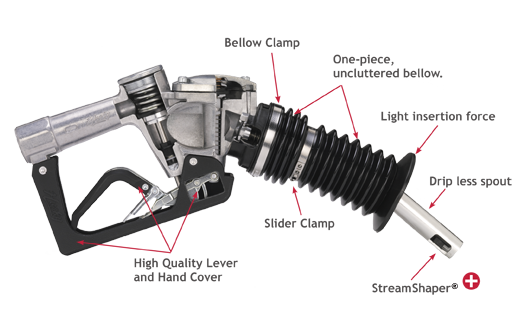
A boot nozzle, also called a fuel bellows or nozzle boot, is an accordion-like device that enables an airtight connection between the distribution nozzle and the fuel port of a tank that is being loaded. It is sleeve-like and made from flexible rubber that covers the port to create an airtight seal. The boot nozzle is an important component of vapor recovery systems to prevent the emission of fuel vapors into the atmosphere.
How a Boot Nozzle Works
They creates a seal at the fueling connection point. Here is how it works:
- The bellows fits around the fuel nozzle
- When inserted into the tank port, the bellows compresses
- The flexible rubber conforms to the port shape
- Airtight seal prevents vapor escape
- Vapors are drawn through the recovery system instead of leaking out
Why Vapor Recovery Matters
The reduce the amount of fuel lost to evaporation. Here is why they are so important:
- Fuel vapors contain volatile organic compounds (VOCs)
- VOCs contribute to ground-level ozone (smog)
- Evaporated fuel is product you cannot sell
- Some vapors are hazardous to breathe
- EPA regulations require vapor recovery
Types of Boot Nozzles
There are bellows for every type of nozzle in the fuel delivery industry. Here are the main types:
Stage I vapor recovery bellows
- Used at refineries and terminals
- Fits large fuel hoses that clamp onto delivery vehicles
- Large diameter for high flow rates
Stage II vapor recovery bellows
- Used at gas stations
- Fits on the pump nozzle that goes into a car
- Smaller diameter
Chemical transfer bellows
- Made of special materials for chemical compatibility
- Resists corrosion from aggressive products
- Used in industrial applications
Materials and Durability
They are made from specialized materials. Here is what you need to know:
Nitrile rubber (NBR)
- Most common material for fuel bellows
- Sturdy and resistant to fuel corrosion
- Good flexibility at normal temperatures
- Affordable and widely available
Fluorocarbon (Viton)
- Resists high temperatures
- Handles aggressive chemicals
- More expensive than nitrile
- Longer service life
Polyurethane
- Very durable and tear-resistant
- Good for cold weather applications
- Less common than rubber
Where Boot Nozzles Are Used
They are found throughout the fuel delivery industry. Here are the most common locations:
- Refinery loading racks
- Oil depot truck loading bays
- Gas station fuel pumps
- Marine fueling docks
- Airport fueling operations
- Railcar loading facilities
- Chemical transfer stations
The whole fuel delivery process creates many occasions where evaporating fuel needs to be recovered before it enters the atmosphere. It is an important component of a vapor recovery system due to the airtight connection it creates at the point of delivery.
For railcar loading systems, boot nozzle seals prevent vapor release during tank car filling.
Inspection and Maintenance
It must be checked regularly. Here is what to inspect:
- Look for tears, cracks, or holes
- Check for hardening or brittleness
- Ensure the bellows compresses and expands properly
- Verify the seal is airtight when connected
- Look for fuel residue indicating leaks
- Check mounting clamps for tightness
Most fuel depot bellows are made from nitrile rubber that is sturdy and resistant to corrosion, but they should be checked frequently for tears and areas where a seal around a fuel loading port may be compromised. Set up an inspection schedule to monitor accordingly. For loading platforms, boot nozzle inspection should be part of daily safety checks.
Replacement and Spare Parts
Having a good supply of replacement boot nozzles is proactive practice. Here is why:
- Boot nozzles wear out over time
- A torn boot nozzle cannot seal properly
- Vapors escape, violating regulations
- Product loss affects profitability
- Downtime waiting for parts costs money
Having a good supply of replacement fuel bellows would be a proactive practice that could affect profit or loss at the end of the year. A spare boot nozzle on hand means no waiting for deliveries when one fails. For spill containment systems, boot nozzle integrity is part of overall environmental protection. Railcar track pans capture any liquid releases while boot nozzles capture vapors.
Environmental Impact
The environmental concerns about vapor loss are very real. Here are the numbers:
- 147 million gallons of gasoline lost each year to evaporation (EPA data)
- Each gallon of gasoline releases about 6 pounds of CO2 when burned
- Evaporated vapors contribute directly to smog
- Vapor recovery with proper boot nozzles prevents this loss
Worker Safety and Boot Nozzles
They also protect workers. Here is how:
- Prevent exposure to toxic fuel vapors
- Reduce fire and explosion risk
- Keep fueling areas cleaner
- Allow workers to breathe easier
It is an important component of vapor recovery systems to prevent the emission of fuel vapors into the atmosphere. Those vapors are not just bad for the environment; they are bad for workers who breathe them all day. For worker protection, drench showers and eyewash stations should be accessible near boot nozzle fueling areas. Safety gates and fall protection systems keep workers safe while inspecting boot nozzles at height.
They, also called a fuel bellows, is an accordion-like rubber sleeve that creates an airtight seal between a fuel nozzle and tank port.
The prevents fuel vapors from escaping into the atmosphere by sealing the connection point during fueling.
Most fuel depot made from nitrile rubber that is sturdy and resistant to fuel corrosion.
According to the EPA, an estimated 147 million gallons of gasoline lost each year due to evaporation.