


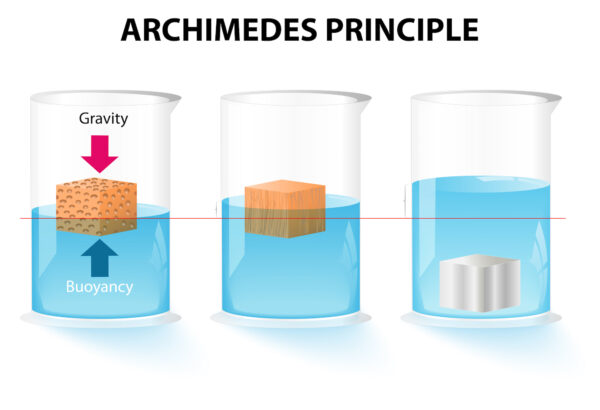
Archimedes’ Principle states that a body immersed in a fluid experiences an upward buoyant force equal to the weight of the fluid it displaces. This force acts at the center of mass of the displaced fluid. The principle applies whether the object is fully or partially submerged.
Industrial Applications
Underground Storage Tanks (USTs)
Groundwater exerts pressure on fuel tanks and other underground structures. Engineers use Archimedes’ Principle to calculate buoyant forces to prevent tanks from floating, tipping, or shifting, which could lead to spills or leaks.
Key considerations include:
- Studying local water tables
- Checking rainfall and flood history
- Designing anchoring systems to counter buoyancy
- Planning spill containment for emergency scenarios
Fuel Storage Safety
Groundwater can cause corrosion and oxidation of metal tanks. Using Archimedes’ Principle, engineers ensure tanks are securely anchored, protecting the environment and preventing costly accidents.
Other Industrial Uses
- Oil and gas pipelines: Ensuring buried pipelines resist upward forces
- Marine engineering: Designing ships, submarines, and pontoons to float safely
- Hydraulic systems: Calculating forces in submerged components
Practical Examples
- A 10,000-gallon fuel tank in a flood-prone area may experience significant upward pressure. Engineers calculate the total buoyant force and install anchor bolts or concrete pads to keep it in place.
- Floating docks rely on Archimedes’ Principle to stay afloat while supporting weight. Engineers calculate displacement for stability.
- Submarines adjust ballast tanks based on the principle to control submersion and surfacing.
It helps engineers prevent floating or displacement caused by groundwater, ensuring structural integrity and environmental safety.
Does the type of fluid matter?
They use the formula:
Buoyant Force = Density of fluid × Volume displaced × Gravity
Yes. If the upward buoyant force exceeds the tank’s weight, it may float or tilt, causing leaks.
Absolutely. It’s used in ships, submarines, balloons, fluid systems, and even everyday objects that float or sink in liquids.