


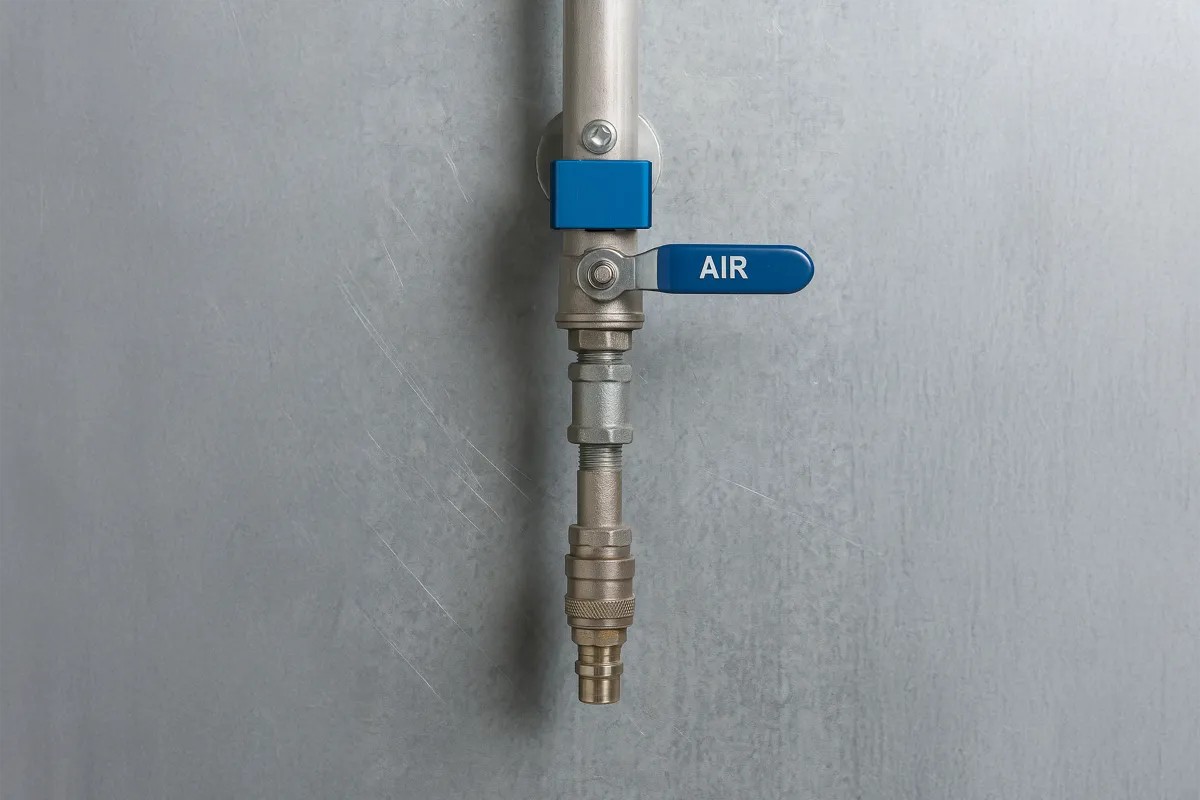
An airdrop is an access point in a compressed air system that allows workers to connect and use compressed air for tools, machines, or industrial processes.
It acts as a convenient connection point where compressed air can be safely taken from the main air supply and delivered to equipment when needed.
How an Airdrop Works
An airdrop is usually installed along the main compressed air supply line, also known as the air header.
Here’s how it functions:
- The air header carries compressed air throughout the facility
- The airdrop is connected to this main line
- An air connector is attached at the airdrop
- Compressed air flows from the system directly into tools or machinery
This setup allows equipment to be connected or disconnected easily without interrupting the entire air system.
Where Airdrops Are Used
Airdrops are commonly used in:
- Manufacturing plants
- Warehouses and distribution centers
- Industrial facilities
- Maintenance and production areas
They are essential in locations where multiple machines or tools rely on compressed air.
Common Uses of Airdrops
- Powering pneumatic tools
- Operating actuators and valves
- Supporting production and maintenance equipment
- Providing flexible air access across large facilities
Why Air drops Are Important
Properly designed air drop systems:
- Improve operational efficiency
- Allow quick equipment connections
- Reduce clutter and minimize trip hazards
- Ensure a reliable and consistent air supply
- Support workplace safety and organization
Related Terms
Air Header – The main pipeline that distributes compressed air from the compressor to different areas of a facility.
Air Connector – The fitting that connects tools or machines to the air drop and allows compressed air to flow.
An airdrop is a connection point that lets workers use compressed air from a central system.
It is installed along the main compressed air line, also called the air header.
They make it easy to connect air-powered tools and machines without modifying the main system.
Yes, when properly designed and installed, they improve safety by reducing loose hoses and tripping hazards.
Pneumatic tools, actuators, valves, and other air-powered machinery commonly use airdrops.