


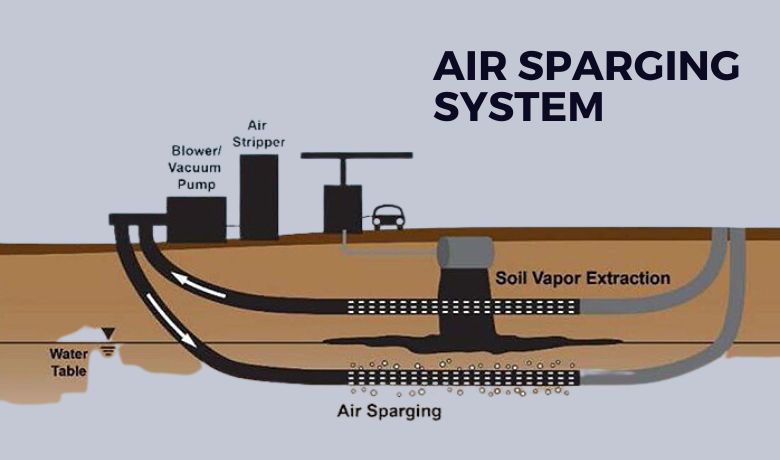
Air sparging is an in-situ remediation technique use to remove contaminants from soil and groundwater. It works by injecting compressed air below the water table, which helps volatilize pollutants and move them upward for removal.
This method is commonly use to treat contamination caused by fuel spills, leaking underground storage tanks, and industrial chemical releases.
How Air Sparging Works
It operates through a simple but effective process:
- Injection: Compressed air is injected into the saturated zone (below the water table).
- Bubble Formation: Air forms bubbles that rise through groundwater.
- Volatilization: Contaminants (especially hydrocarbons) convert into vapors.
- Migration: Vapors move upward into the soil above the water table.
- Extraction: Vapors are typically capture using soil vapor extraction (SVE) systems.
Key Insight: It does not destroy contaminants directly—it transfers them from liquid to vapor form for easier removal.
Common Contaminants Treated
It is most effective for volatile and semi-volatile organic compounds, including:
- Petroleum hydrocarbons (gasoline, diesel)
- Benzene, toluene, ethylbenzene, xylene (BTEX compounds)
- Industrial solvents
- Certain volatile organic compounds (VOCs)
Applications
- Fuel spill remediation
- Leaking underground storage tanks (USTs)
- Petroleum-contaminated sites
- Industrial cleanup projects
- Groundwater restoration programs
Advantages of Air Sparging
- Cost-effective compared to excavation methods
- In-situ process (no need to remove soil)
- Efficient for volatile contaminants
- Improves groundwater quality over time
- Can be combine with soil vapor extraction (SVE) for better results
To remove contaminants from groundwater and soil by converting them into vapors for extraction.
Yes, when properly designed and monitored, it is a safe and effective remediation method.
Primarily volatile organic compounds (VOCs) and petroleum-based pollutants.
It depends on contamination levels and site conditions, but it can take months to years.
Often combined with soil vapor extraction (SVE) for improved efficiency.