





SafeRack Gangway & OPW Loading Arm Installation | Safe Biosolids Loading in a Growing Arizona Municipality
As one of the fastest-growing communities in the Tucson metropolitan area, Marana, Arizona faces a challenge common to expanding municipalities: managing an increasing volume of biosolids generated by wastewater treatment.
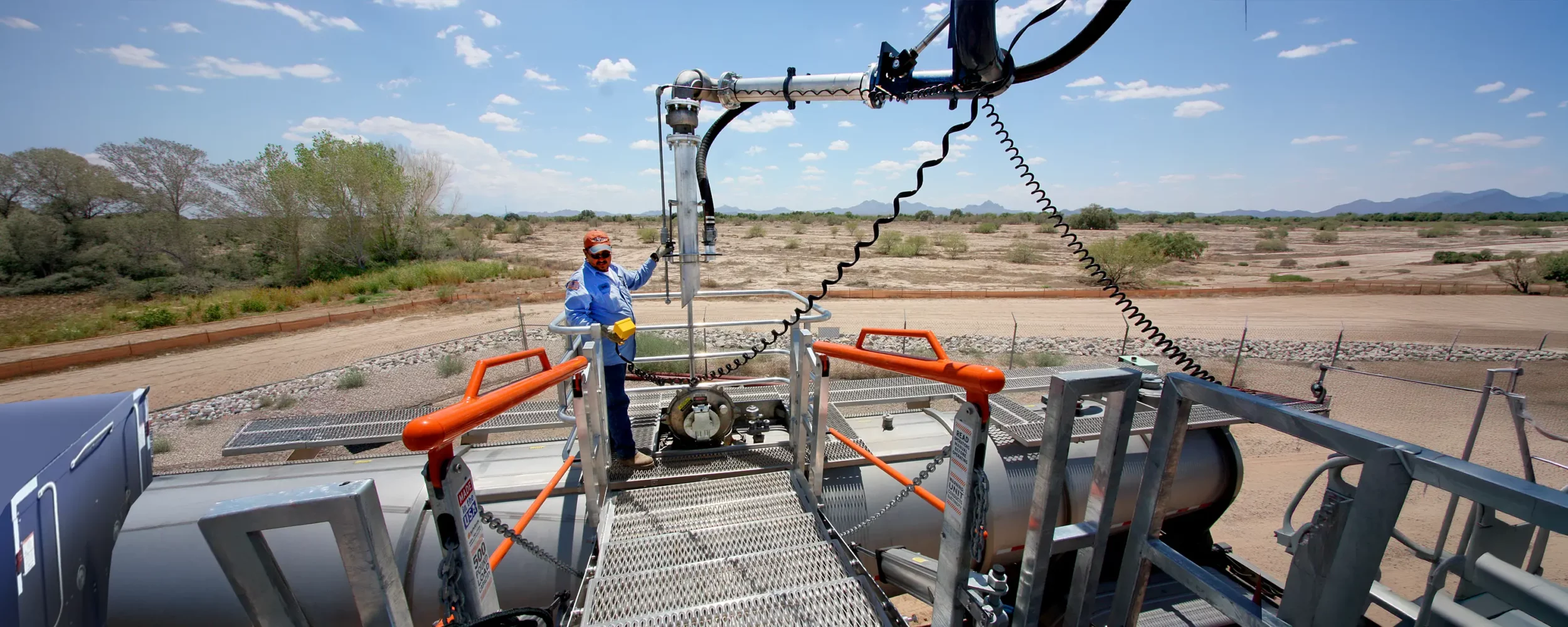
In Arizona, approximately 90% of wastewater solids are recycled through Class B land application on agricultural land, a practice in place since the 1960s. This beneficial reuse model turns a disposal liability into a soil amendment resource—but it requires infrastructure capable of safely and efficiently loading tanker trucks in compliance with federal and state regulations. The Marana WWTP’s installation of a SafeRack gangway and OPW top loading arm system directly addresses that need.
Project Background
Marana’s wastewater treatment plant processes municipal sewage through standard primary, secondary, and sludge treatment stages, producing liquid biosolids in the 3–8% solids range. These biosolids must be loaded into tanker trucks for transport to permitted agricultural land application sites in the surrounding farming community. Before this installation, the facility needed a purpose-built loading terminal station that would provide operators with safe, elevated access to tanker dome hatches while meeting OSHA 1910 fall protection standards and supporting the throughput demands of a growing service area. The station also had to comply with EPA 40 CFR Part 503 biosolids land application requirements, which govern pollutant limits, pathogen reduction, and vector attraction controls for Class B material applied to agricultural land.
Equipment Description
The heart of the installation is an OPW counterbalanced articulating top loading arm, which allows operators to position the loading tube precisely into the tanker’s dome hatch opening for liquid biosolids transfer. The arm’s counterbalance mechanism reduces physical strain and enables smooth, one-handed repositioning across varying tanker heights. SafeRack supplies integrated loading arm solutions coordinated with gangways, fall protection, and vehicle-specific variables—an approach that eliminates the design conflicts common when sourcing components separately.
The adjustable SafeRack gangway bridge spans from the fixed platform to the top of the tanker truck, featuring an anti-slip expanded-metal deck that self-levels to accommodate varying vehicle heights. The gangway’s articulating design ensures a stable walking surface regardless of tanker size or position. Construction uses corrosion-resistant aluminum and stainless steel components selected for compatibility with biosolids chemistry and the harsh, high-temperature Marana desert environment.
Safety Features
Operator safety was the primary design driver. The station incorporates several OSHA 1910-compliant features:
- Orange safety railings or cages provide continuous guardrail protection around the gangway and around the loading position.
- Pendant-style operator control box allows the operator to manage pump activation, valve sequencing, flow rate, and overfill prevention from a safe, ergonomic position atop the gangway—eliminating the need to climb down to ground-level controls during loading.
- Anti-slip expanded metal decking reduces slip hazards in conditions where biosolids residue or desert dust could create a slick surface.
SafeRack’s gangway systems are engineered to provide secure access while minimizing fall risks, making them well suited for handling bulk liquids in industrial and municipal settings.
Environmental and Community Benefit
Marana’s biosolids land application program operates under the regulatory framework established by EPA 40 CFR Part 503 and administered at the state level by the Arizona Department of Environmental Quality (ADEQ) under Arizona Administrative Code R18-9-1004. Land application of biosolids delivers documented environmental benefits including improved soil health, carbon sequestration, reduced demand on non-renewable fertilizer resources like phosphorus, and lower greenhouse gas emissions compared to landfill disposal.
For the Marana farming community, this means a locally sourced, nutrient-rich soil amendment that supports crop production in arid soils while diverting material from landfills. Arizona’s long history of biosolids agricultural reuse—and the fact that the state recycles nearly all of its wastewater solids to land—underscores the practical and economic viability of this approach.
Scalability and Project Success
The Marana biosolids top loading station demonstrates how a well-integrated SafeRack gangway and OPW loading arm system can solve a common municipal challenge: getting biosolids from the treatment plant into tanker trucks safely, efficiently, and in full regulatory compliance. The modular, corrosion-resistant design is built for low maintenance in extreme heat and arid conditions, and the configuration is directly scalable to other municipal and industrial facilities handling similar liquid bulk materials. For wastewater utilities evaluating loading infrastructure upgrades, this project provides a proven template that balances operator safety, regulatory compliance, and long-term durability.
Spill Containment
SPCC and EPA compliant solutions. Railcar track pans, truck spill containment, drum and IBC spill pallets, and industrial containment berms.

Loading Arms & Couplings
Truck, rail, and marine bulk fluid transfer top/bottom loading arms, couplings, swivel joints, hoses, and breakaways.
Truck Gangways
The industry’s safest and most ergonomic gangway for truck loading and access.
Safety Gates
Industrial safety swing gates, facility guardrails, mezzanine gates and barriers gates.
Pipe Racks
Prefabricated Pipe Racks Constructed Faster and Easier Than Ever Before
Tools and Loading Accessories
A comprehensive range of facility and loading terminal equipment, accessories and safety solutions.
Sources:
Federal Regulations
- U.S. EPA, 40 CFR Part 503 — Standards for the Use or Disposal of Sewage Sludge. Code of Federal Regulations, Title 40, Chapter I, Subchapter O. Available at: https://www.ecfr.gov/current/title-40/chapter-I/subchapter-O/part-503
- U.S. EPA, “A Plain English Guide to the EPA Part 503 Biosolids Rule.” EPA/832/R-93/003, September 1994. Available at: https://www.epa.gov/biosolids/plain-english-guide-epa-part-503-biosolids-rule
- U.S. EPA, “Land Application of Biosolids.” U.S. Environmental Protection Agency, Office of Water. Available at: https://www.epa.gov/biosolids/land-application-biosolids
- OSHA 29 CFR 1910.28 — Duty to Have Fall Protection and Falling Object Protection. Occupational Safety and Health Administration, Subpart D: Walking-Working Surfaces. Available at: https://www.osha.gov/laws-regs/regulations/standardnumber/1910/1910.28
- OSHA 29 CFR 1910.29 — Fall Protection Systems and Falling Object Protection: Criteria and Practices. Occupational Safety and Health Administration, Subpart D. Referenced in conjunction with 1910.28 for guardrail, toeboard, and fall protection system specifications.
State Regulations
- Arizona Administrative Code R18-9-1001 through R18-9-1014 — Biosolids Program. Arizona Department of Environmental Quality (ADEQ), regulating the generation, disposal, and beneficial use of domestic biosolids under the Arizona Pollutant Discharge Elimination System (AZPDES) permitting program.
- Arizona State Senate SB1212 (2025) — Biosolids Application to Agricultural Land. Requires the ADEQ Director to adopt rules for biosolids application to agricultural land. Available at: https://legiscan.com/AZ/supplement/SB1212
Industry and Data Sources
- National Biosolids Data Project — Arizona. Biosolids generation, use, and disposal data for the state of Arizona. Available at: https://www.biosolidsdata.org/arizona
- University of Arizona Cooperative Extension, “Biosolids Land Use in Arizona.” Publication AZ1426. Available at: http://www.ceresbiosystems.org/pdf/az1426.pdf
- University of Arizona, “The Dirt on PFAS and Biosolid Land Applications.” College of Agriculture, Life and Environmental Sciences, February 2026. Available at: https://cales.arizona.edu/news/dirt-pfas-and-biosolid-land-applications